 Bug FAQ
Mexican Honey Wasp
Brachygastra mellifica · Order: Hymenoptera · Family: Vespidae

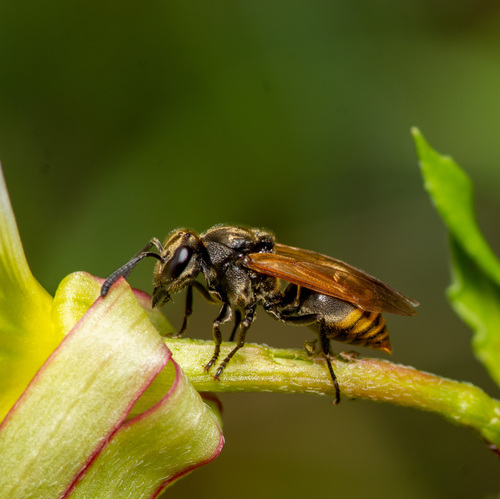
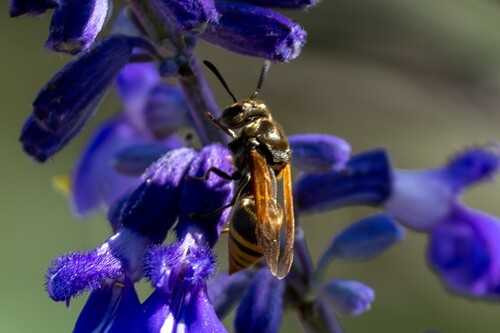
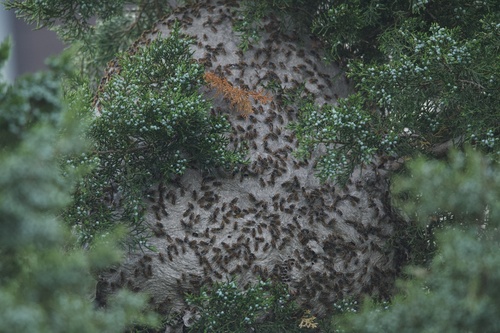
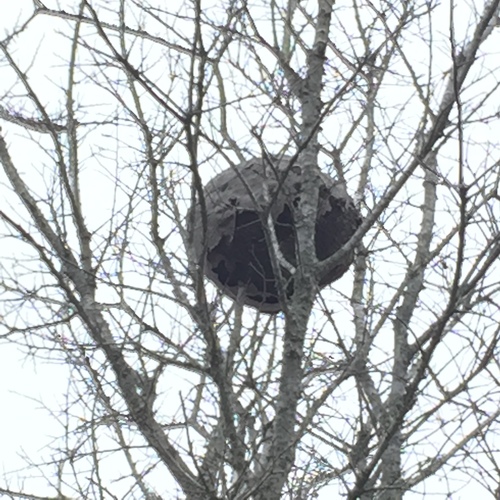
The Mexican honey wasp is a small wasp about 7-9 mm long with yellow and black bands on the abdomen in workers and males, while queens are dark reddish-brown. It builds nests in the canopy of shrubs or trees, often 1 to 9 m above ground, and is common in suburban areas near humans in Central America, Mexico, southern Arizona and Texas. The wasp feeds on the Asian citrus psyllid and occasionally on weevil larvae and small moths, making it useful for biological control of these pests.
Source: Wikipedia
How to recognize it
Workers and males have alternating yellow and black bands on the abdomen; queens are dark reddish-brown.
Source: Wikipedia
Size
Body length is about 7-9 mm.
Source: Wikipedia
Does it bite or sting?
Only female wasps have stingers; males do not.
Source: Wikipedia
How to get rid of it
Considered a potential biological control agent because it can be moved easily, grows quickly, and can be preserved in closed systems.
Source: Wikipedia
Where it lives
Nests are built in the canopy of shrubs or trees, 1 to 9 m above ground. Nests are often found in suburban settings close to human habitation.
Source: Wikipedia
What it eats
Primarily hunts the Asian citrus psyllid, a major prey item. May also eat larvae of the weevil Anthonomus aeneoulus and small moths of the family Alucitidae.
Source: Wikipedia
Life cycle
Queens can either stay in the original colony to mate and reproduce or swarm with workers to start a new colony.
Source: Wikipedia
When you see it
Populations peak in July and September when citrus groves and psyllid numbers are high.
Source: Wikipedia
Where it comes from
Also present in southeastern Arizona and the southernmost counties of Texas.
Source: Wikipedia
Where it is found in the US
Recorded in 2 of 51 states and DC. Most records: Texas, Arizona.
Darker = more records. Counts are museum and citizen-science records, not population size.
Source: GBIF
Months it is reported in the US
Source: GBIF
More photos
Questions people ask
Do they sting?
Only the females have a stinger, but there is no information on how dangerous a sting might be.
Source: Wikipedia
Can they be used for pest control?
Yes, they are suggested as natural biological control agents for citrus psyllids and other small insects.
Source: Wikipedia
Same family (Vespidae)


Sources
- Wikipedia: https://en.wikipedia.org/wiki/Brachygastra_mellifica
Look it up elsewhere: GBIF · iNaturalist · BugGuide · Wikipedia
Text written 2026-10-22 from the sources above and checked sentence by sentence against them. Data fetched 2026-10-22.