 Bug FAQ
Metallic wood-boring beetle
Trachys minutus · Order: Coleoptera · Family: Buprestidae
Source: Wikipedia

These beetles are very small, only about 3 to 3.5 mm long and have a dark, shiny, slightly hairy surface. Females lay eggs on the leaves of deciduous trees such as elm, and the hatching larvae feed between the leaf layers, creating mines that damage the leaves.
Source: Wikipedia
How to recognize it
They are dark colored, shiny and have a slight covering of hairs.
Source: Wikipedia
Size
Adults measure between 3 and 3.5 mm in length.
Source: Wikipedia
Life cycle
Eggs are deposited on deciduous tree leaves, and the emerging larvae mine the leaves as they feed.
Source: Wikipedia
Where it comes from
The species occurs across most of Europe, the eastern Palearctic region and the Near East.
Source: Wikipedia
Where it is found in the US
Recorded in 1 of 51 states and DC. Most records: Massachusetts.
Darker = more records. Counts are museum and citizen-science records, not population size.
Source: GBIF
Status: introduced in United States. Source: iNaturalist
More photos


Questions people ask
What damage do the larvae cause?
The larvae create mines inside leaves, eating the tissue between the leaf layers and damaging the foliage.
Source: Wikipedia
What do these beetles look like?
They are dark, shiny and have a slight covering of hairs.
Source: Wikipedia
Same family (Buprestidae)
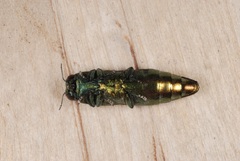 Emerald Ash BorerAgrilus planipennisDamages trees, gardens or crops
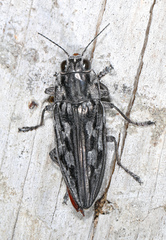 Sculptured Pine BorerChalcophora virginiensisDamages trees, gardens or crops
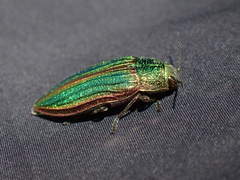 Golden Buprestid BeetleBuprestis aurulenta
 Anthaxia nitidulaAnthaxia nitidulaDamages trees, gardens or crops
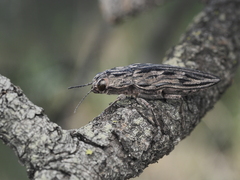 Western Sculptured Pine BorerChalcophora angulicollis
 Anthaxia quadripunctataAnthaxia quadripunctata
Sources
- Wikipedia: https://en.wikipedia.org/wiki/Trachys_minutus
Look it up elsewhere: GBIF · iNaturalist · BugGuide · Wikipedia
Text written 2026-10-23 from the sources above and checked sentence by sentence against them. Data fetched 2026-10-22.