 Bug FAQ
Anthaxia quadripunctata
Anthaxia quadripunctata · Order: Coleoptera · Family: Buprestidae


Anthaxia quadripunctata is a small beetle about 4.5 to 8 mm long and shines black or dark brown with a copper tint. It lives on the edges of conifer forests in mountains, where larvae bore under bark of sick or dead trees and adults feed on pollen of white and yellow Asteraceae flowers from spring to early autumn.
Source: Wikipedia
How to recognize it
The beetle’s pronotum is almost rectangular and usually has four tiny dimples, which give the species its name.
Source: Wikipedia
Size
Adults measure between 4.5 and 8 mm in length.
Source: Wikipedia
Where it lives
They are found in mountainous areas with coniferous trees, especially near forest edges.
Source: Wikipedia
What it eats
Larvae feed under the bark of sick or dead conifers, while adults eat pollen from various Asteraceae flowers, preferring white and yellow blossoms.
Source: Wikipedia
Life cycle
Larvae develop as wood-boring insects under bark of weakened conifers; adults emerge and are active from April to September, feeding and mating on pollen.
Source: Wikipedia
When you see it
Adults are on the wing from April through September.
Source: Wikipedia
More photos


Questions people ask
When are these beetles active?
Adults are active and can be seen flying from April to September.
Source: Wikipedia
Same family (Buprestidae)
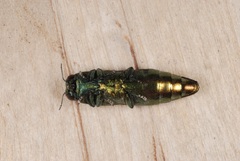 Emerald Ash BorerAgrilus planipennisDamages trees, gardens or crops
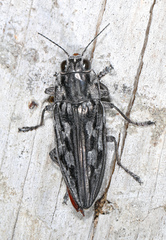 Sculptured Pine BorerChalcophora virginiensisDamages trees, gardens or crops
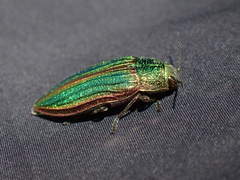 Golden Buprestid BeetleBuprestis aurulenta
 Anthaxia nitidulaAnthaxia nitidulaDamages trees, gardens or crops
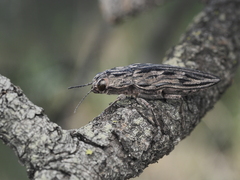 Western Sculptured Pine BorerChalcophora angulicollis
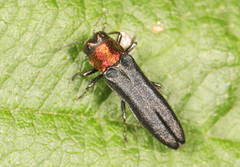 Red-necked Cane BorerAgrilus ruficollis
Sources
- Wikipedia: https://en.wikipedia.org/wiki/Anthaxia_quadripunctata
Look it up elsewhere: GBIF · iNaturalist · BugGuide · Wikipedia
Text written 2026-10-23 from the sources above and checked sentence by sentence against them. Data fetched 2026-10-22.