 Bug FAQ
Emerald Ash Borer
Agrilus planipennis · Order: Coleoptera · Family: Buprestidae
Source: Wikipedia, USDA APHIS
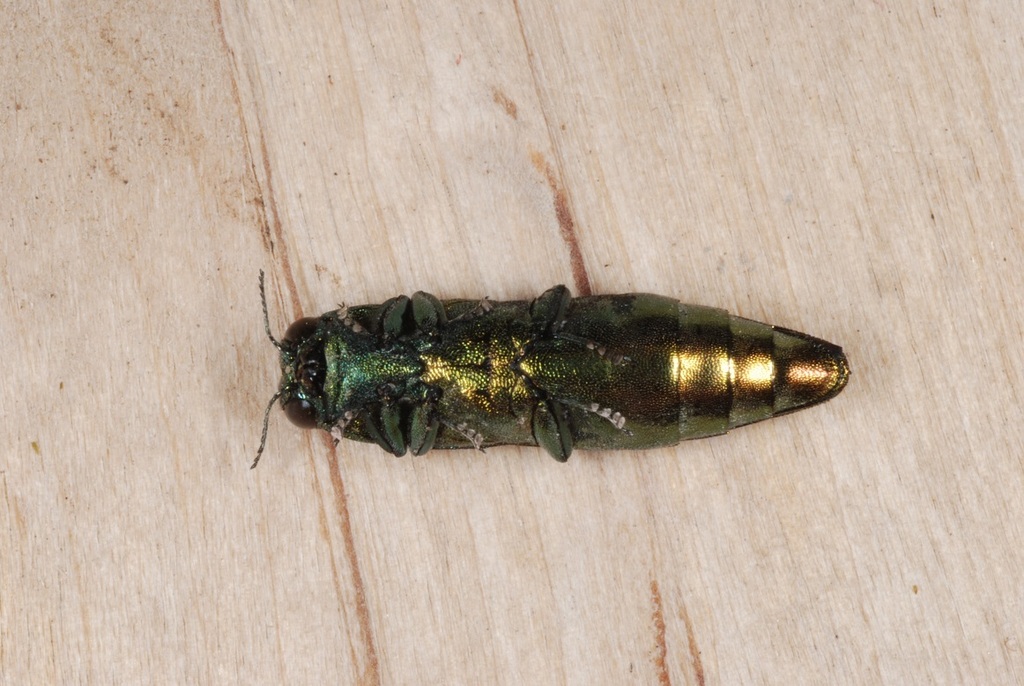
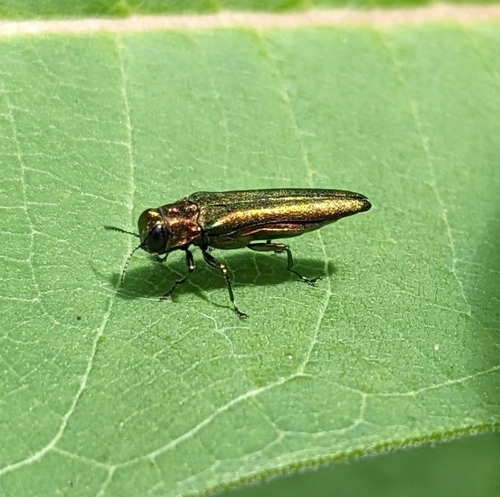
Adult beetles are bright metallic green about half an inch long with a copper-red abdomen. Females lay eggs in bark crevices of ash trees and the larvae feed under the bark, creating S-shaped galleries. Adults emerge in late spring after enough warm days have accumulated, and the life cycle may take one or two years.
Source: Wikipedia, USDA APHIS
How to recognize it
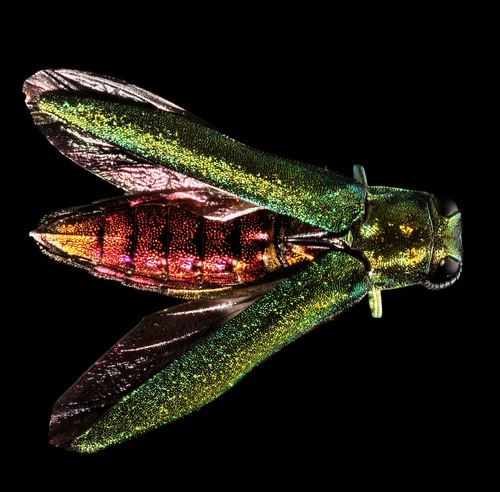
Adults are metallic green with a bright red upper abdomen when the wings are spread.
Source: Wikipedia
Is it a pest in the house?
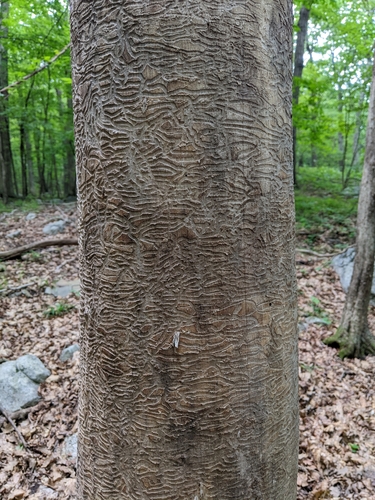
It can kill healthy ash trees in forests, urban, suburban and rural settings. Infested trees may show dead upper branches, excessive branching on trunks, and vertical bark cracks. Tracks or galleries are sometimes visible under the bark of damaged trees.
Source: USDA APHIS, Wikipedia
How to get rid of it
Local governments monitor its spread, diversify tree species, and use insecticides or biological control. Treatment options are available at retail outlets and through cooperative extension agents.
Source: Wikipedia, USDA APHIS
What it eats
Larvae feed on the inner bark and phloem of ash trees. It primarily infests green ash, black ash, white ash, and blue ash in North America.
Source: USDA APHIS, Wikipedia
Life cycle
The life cycle can be completed in one or two years depending on oviposition time, tree health, and temperature.
Source: Wikipedia
When you see it
Adults emerge in late spring after 400 to 500 degree-days above 10 °C, with peak emergence around 1,000 degree-days.
Source: Wikipedia
Where it comes from
The emerald ash borer is native to northeastern Asia.
Source: Wikipedia
Lookalikes
Other beetles are often misidentified as emerald ash borer by the public.
Source: Wikipedia
Where it is found in the US
Recorded in 37 of 51 states and DC. Most records: New York, Minnesota, Pennsylvania, Wisconsin, Michigan, Texas, New Jersey, Ohio.
Darker = more records. Counts are museum and citizen-science records, not population size.
Source: GBIF
Status: introduced in Canada; introduced in United States. Source: iNaturalist
Months it is reported in the US
Source: GBIF
More photos
Questions people ask
How can I tell if I have an emerald ash borer infestation?
Look for S-shaped galleries under the bark, dead upper branches, and vertical cracks in the bark of ash trees.
Source: USDA APHIS
When do the adults appear?
Adults emerge in late spring after enough warm days have accumulated, usually peaking around 1,000 degree-days above 10 °C.
Source: Wikipedia
What trees does it affect?
It attacks ash species such as green ash, black ash, white ash, and blue ash.
Source: Wikipedia
Same family (Buprestidae)
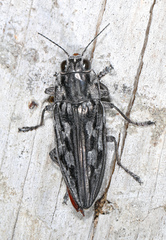 Sculptured Pine BorerChalcophora virginiensisDamages trees, gardens or crops
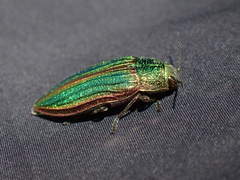 Golden Buprestid BeetleBuprestis aurulenta
 Anthaxia nitidulaAnthaxia nitidulaDamages trees, gardens or crops
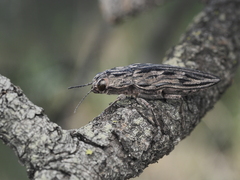 Western Sculptured Pine BorerChalcophora angulicollis
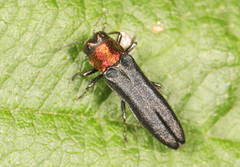 Red-necked Cane BorerAgrilus ruficollis
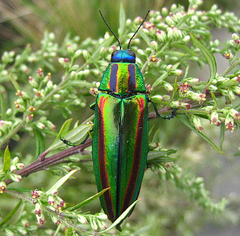 Japanese Jewel BeetleChrysochroa fulgidissima
Sources
- Wikipedia: https://en.wikipedia.org/wiki/Emerald_ash_borer
- USDA APHIS: https://www.aphis.usda.gov/plant-pests-diseases/eab
Look it up elsewhere: GBIF · iNaturalist · BugGuide · ITIS · Wikipedia
Text written 2026-10-22 from the sources above and checked sentence by sentence against them. Data fetched 2026-10-22.