 Bug FAQ
Marbled Orbweaver
Araneus marmoreus · Order: Araneae · Family: Araneidae
Also called: Angulate & Roundshouldered Orbweaver, Marbled orb-weaver, Pumpkin Spider

Adult females have a large, round abdomen up to about 14 mm long, while males are about half that size. The spider builds vertical webs in moist, wooded areas and hides in a silk retreat attached to a signal thread.
Source: Wikipedia
How to recognize it
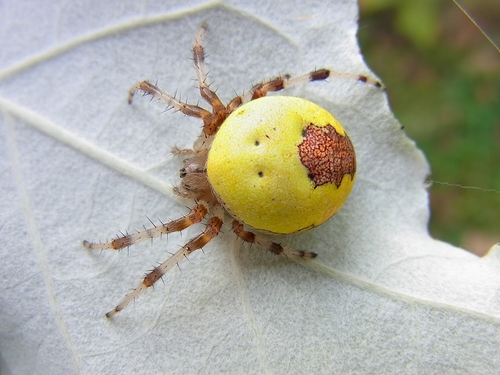
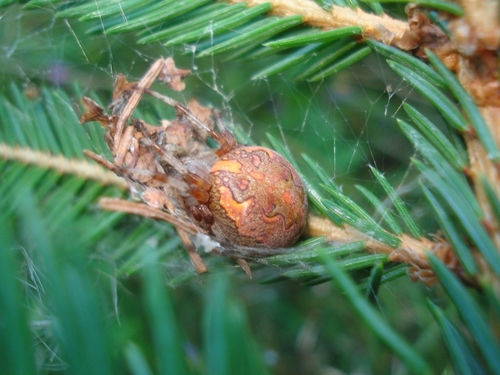
The typical form has an orange abdomen with dark marbling and a distinct leaf-shaped marking. A paler form shows a single dark reddish-brown spot near the rear of the abdomen.
Source: Wikipedia
Size
Females can reach 14 mm or more in body length; males are up to about 7 mm.
Source: Wikipedia
Where it lives
Webs are found in trees, shrubs, tall weeds and grasses, often near streams in moist woods. The spider’s retreat may be a folded leaf held with silk or just silk alone, placed under debris.
Source: Wikipedia
What it eats
The vertical web has a signal thread that alerts the spider when prey is caught. Unlike garden spiders, the marbled orbweaver stays in a side retreat rather than on the web itself.
Source: Wikipedia
Life cycle
In October the spider lays egg cocoons made of white silk in a flattened sphere. Spiderlings hatch in spring; adults appear midsummer and remain until the first hard freeze.
Source: Wikipedia
Where it comes from
It occurs across the Holarctic region, from North America through Europe to Japan.
Source: Wikipedia
Lookalikes
The female’s round orange abdomen gives it the nickname “pumpkin spider.” It can be confused with Argiope garden spiders, but it hides in a side retreat.
Source: Wikipedia
Where it is found in the US
Recorded in 46 of 51 states and DC. Most records: North Carolina, Virginia, Pennsylvania, Maryland, Georgia, Ohio, New York, Alabama.
Darker = more records. Counts are museum and citizen-science records, not population size.
Source: GBIF
Status: native in North America; native in United States; native in Canada. Source: iNaturalist
Months it is reported in the US
Source: GBIF
More photos
Same family (Araneidae)


Sources
- Wikipedia: https://en.wikipedia.org/wiki/Araneus_marmoreus
Look it up elsewhere: GBIF · iNaturalist · BugGuide · ITIS · Wikipedia
Text written 2026-10-22 from the sources above and checked sentence by sentence against them. Data fetched 2026-10-22.