 Bug FAQ
Mallodon downesii
Mallodon downesii · Order: Coleoptera · Family: Cerambycidae
Source: Wikipedia

Adults are dark brown to black and range from about 33 to 65 mm in length, with females larger than males and males having longer curved mandibles. The larvae grow to about 85 mm long and develop inside rotting wood of many host trees. They are found throughout most of sub-Saharan Africa and Madagascar.
Source: Wikipedia
How to recognize it
The beetles are dark brown to black in colour. Males have longer, curved mandibles while females are generally larger.
Source: Wikipedia
Size
Adults measure roughly 33 to 65 mm (1.3 to 2.6 in) long. Larvae can reach about 85 mm (3.3 in) in length.
Source: Wikipedia
Where it lives
Eggs are laid in decaying wood.
Source: Wikipedia
What it eats
Both adults and larvae feed on a variety of trees including cacao, coconut, avocado, tamarind, acacia and several others.
Source: Wikipedia
Life cycle
The species reproduces by depositing eggs in rotting wood, where the larvae develop before emerging as adults.
Source: Wikipedia
Where it comes from
It occurs widely across the Afrotropical region and Madagascar, including countries such as Kenya, South Africa, Ghana and many others.
Source: Wikipedia
More photos


Questions people ask
Which plants are affected by Mallodon downesii?
It attacks many trees such as cacao, coconut, avocado, tamarind, acacia, rubber, and several others listed in its host range.
Source: Wikipedia
Same family (Cerambycidae)
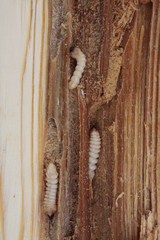 House LonghornHylotrupes bajulusCan damage your home
 Asian Longhorned BeetleAnoplophora glabripennisDamages trees, gardens or crops
 Red Milkweed BeetleTetraopes tetrophthalmus
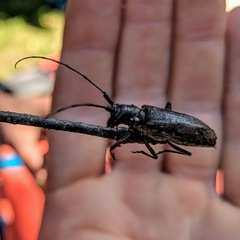 White-spotted SawyerMonochamus scutellatusCan damage your home
 Red Pine Longhorn BeetleStictoleptura rubra
 Spotted Longhorn BeetleRutpela maculataDamages trees, gardens or crops
Sources
- Wikipedia: https://en.wikipedia.org/wiki/Mallodon_downesi
Look it up elsewhere: GBIF · iNaturalist · BugGuide · Wikipedia
Text written 2026-10-23 from the sources above and checked sentence by sentence against them. Data fetched 2026-10-23.