 Bug FAQ
Lobed Mason Wasp
Ancistrocerus antilope · Order: Hymenoptera · Family: Vespidae
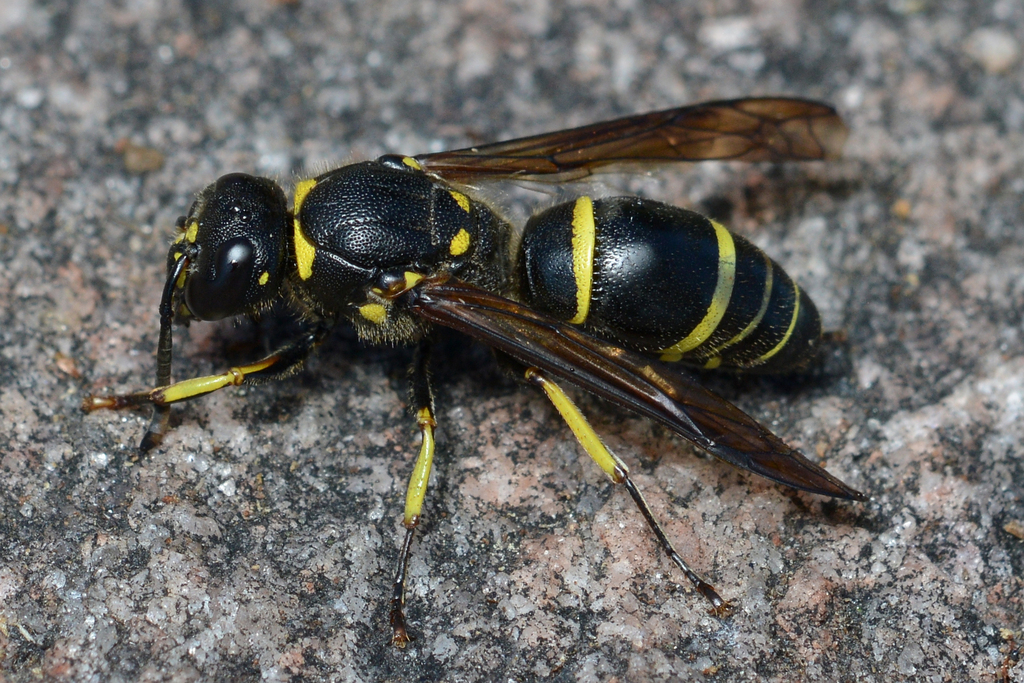
Ancistrocerus antilope nests in hollow twigs and can host the parasite Leucospis affinis, though the parasite's development is uncertain. It is found across all Canadian provinces and most of the continental United States (except Alaska, Alabama, and Florida) and extends into Europe to Siberia.
Source: Wikipedia
How to recognize it
The wasp can be identified by its impunctate propodeum and the pair of yellow scutellar spots on females.
Source: Wikipedia
Size
Females have a shining, smooth propodeum and display two yellow spots on the scutellum.
Source: Wikipedia
Life cycle
The species nests in hollow twigs and its nests have been found to contain the parasite Leucospis affinis, though the parasite's development in the wasp is uncertain.
Source: Wikipedia
Where it comes from
Its range also reaches Europe and Siberia.
Source: Wikipedia
Lookalikes
It is similar in appearance to the rarer Ancistrocerus spinolae.
Source: Wikipedia
Where it is found in the US
Recorded in 26 of 51 states and DC. Most records: Illinois, Pennsylvania, Michigan, Minnesota, Maryland, Utah, West Virginia, Wisconsin.
Darker = more records. Counts are museum and citizen-science records, not population size.
Source: GBIF
Status: native in North America; native in United States; native in Canada. Source: iNaturalist
Months it is reported in the US
Source: GBIF
Questions people ask
What does Ancistrocerus antilope look like?
Females have a smooth, shining propodeum and two yellow spots on the scutellum, which help tell it apart from the similar A. spinolae.
Source: Wikipedia
Where is Ancistrocerus antilope found?
It lives throughout all Canadian provinces and most of the continental United States, except Alaska, Alabama, and Florida, and also occurs in Europe to Siberia.
Source: Wikipedia
Where does Ancistrocerus antilope nest?
It builds its nests in hollow twigs, much like many Megachilid bees.
Source: Wikipedia
Same family (Vespidae)


Sources
- Wikipedia: https://en.wikipedia.org/wiki/Ancistrocerus_antilope
Look it up elsewhere: GBIF · iNaturalist · BugGuide · Wikipedia
Text written 2026-10-25 from the sources above and checked sentence by sentence against them. Data fetched 2026-10-25.