 Bug FAQ
Leucauge tessellata
Leucauge tessellata · Order: Araneae · Family: Tetragnathidae

Leucauge tessellata lives in forested areas across Asia, including India, China, Thailand, Vietnam, Laos, Taiwan, and the Moluccas. In the Darjeeling region it is found from about 600 to 5,000 feet (180 to 1,500 m) and is most common during the monsoon season. It is similar in overall size, shape and colour to L. celebesiana.
Source: Wikipedia
How to recognize it
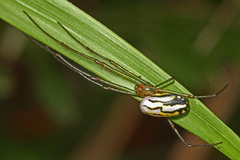
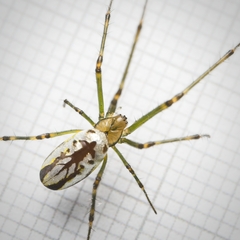
Females have dense, relatively long black hairs on the distal two-thirds of the tibiae of the fourth leg pair. Males have slightly larger eyes and large dark palpal organs with both inner and outer tarsal apophyses.
Source: Wikipedia
Size
The species resembles L. celebesiana in overall size, form and coloration.
Source: Wikipedia
Where it lives
It typically inhabits forested areas at various elevations. In Darjeeling it occurs from roughly 180 m to 1,500 m above sea level.
Source: Wikipedia
Where it comes from
Leucauge tessellata is widely distributed across Asia.
Source: Wikipedia
Lookalikes
It looks like L. celebesiana, but the female’s leg-hair pattern and the male’s palpal structure provide reliable differences.
Source: Wikipedia
More photos


Questions people ask
How can I identify a male Leucauge tessellata?
Males have slightly larger eyes and large dark palpal organs with both inner and outer tarsal apophyses.
Source: Wikipedia
What habitats does Leucauge tessellata prefer?
It lives in forested areas at a range of elevations, from low hills up to about 1,500 m.
Source: Wikipedia
Same family (Tetragnathidae)




Sources
- Wikipedia: https://en.wikipedia.org/wiki/Leucauge_tessellata
Look it up elsewhere: GBIF · iNaturalist · BugGuide · ITIS · Wikipedia
Text written 2026-10-23 from the sources above and checked sentence by sentence against them. Data fetched 2026-10-22.