 Bug FAQ
Silver Orb Spider
Leucauge dromedaria · Order: Araneae · Family: Tetragnathidae
Also called: Horizontal Orbweb Spider

The humped silver orb spider can reach up to about 15 mm in body length for females. It is recognizable by a pair of humps on its abdomen and belongs to the long-jawed orb weaver group. It occurs naturally in Australia, New Zealand and several South Pacific islands.
Source: Wikipedia
How to recognize it
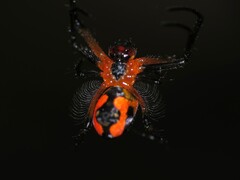
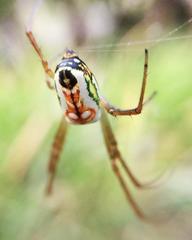
The abdomen has a distinctive second pair of humps.
Source: Wikipedia
Size
Females can grow to a body length of about 15 mm, making it a medium to large orb-weaver.
Source: Wikipedia
Where it comes from
It is native to Australia, New Zealand and some South Pacific islands.
Source: Wikipedia
Lookalikes
It is a member of the long-jawed orb-weaver spiders.
Source: Wikipedia
More photos

Questions people ask
How big does the humped silver orb spider get?
Females can reach about 15 mm in body length, which is medium to large for an orb-weaver.
Source: Wikipedia
What distinctive markings does this spider have?
It has a second pair of humps on its abdomen.
Source: Wikipedia
Where is this spider originally from?
It is found naturally in Australia, New Zealand and several South Pacific islands.
Source: Wikipedia
Same family (Tetragnathidae)


Sources
- Wikipedia: https://en.wikipedia.org/wiki/Leucauge_dromedaria
Look it up elsewhere: GBIF · iNaturalist · BugGuide · ITIS · Wikipedia
Text written 2026-10-22 from the sources above and checked sentence by sentence against them. Data fetched 2026-10-22.