 Bug FAQ
Decorative Vleispider
Leucauge decorata · Order: Araneae · Family: Tetragnathidae

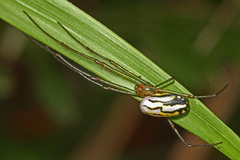
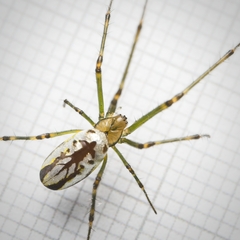
Females grow up to 12 mm long and males up to 6 mm, with an elongated abdomen that tapers into a tail-like tip past the spinnerets. The abdomen shows green bands on a white background. It builds large orb-webs in forests, grasslands, rice fields, urban areas and sometimes near water or in damp shade.
Source: Wikipedia
How to recognize it
It has an elongate abdomen that extends past the spinnerets like a tail.
Source: Wikipedia
Size
Females reach up to 12 mm body length, males up to 6 mm.
Source: Wikipedia
Where it lives
It builds large orb-webs, often near water or in shaded, damp places.
Source: Wikipedia
Where it comes from
It has a wide Paleotropic distribution.
Source: Wikipedia
Lookalikes
It belongs to the long-jawed orb-weaver group.
Source: Wikipedia
More photos


Questions people ask
What does the decorative vleispider look like?
It has a long, tail-like abdomen with green bands on a white background and reaches up to 12 mm in females.
Source: Wikipedia
Where can I find decorative vleispiders?
They build large orb-webs in forests, grasslands, rice fields, urban areas and sometimes near water or in damp shade.
Source: Wikipedia
Same family (Tetragnathidae)




Sources
- Wikipedia: https://en.wikipedia.org/wiki/Leucauge_decorata
Look it up elsewhere: GBIF · iNaturalist · BugGuide · ITIS · Wikipedia
Text written 2026-10-23 from the sources above and checked sentence by sentence against them. Data fetched 2026-10-22.