 Bug FAQ
Lesser Grain Borer
Rhyzopertha dominica · Order: Coleoptera · Family: Bostrichidae
Also called: American wheat weevil, Australian wheat weevil, Wheat Weevil
Source: Wikipedia
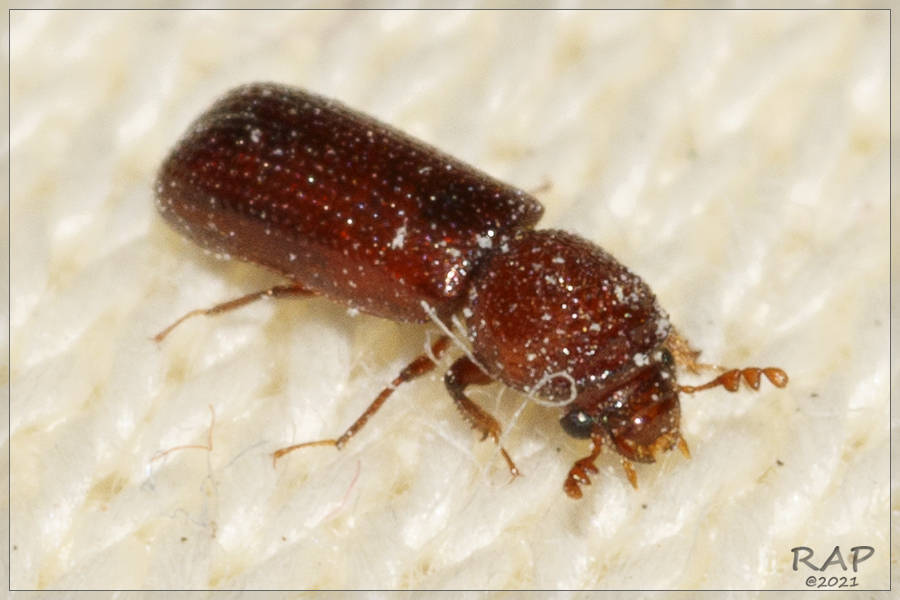
Adults are tiny, about 2.1 to 3.0 mm long, and have a reddish-brown, elongated, cylindrical body with a distinct three-segment antennal club. They live in forests and grain storage sites, originated likely from the Indian subcontinent, and now occur worldwide in warm temperate regions. The beetle feeds on many stored grains and legumes, completing its egg-larva-pupa-adult cycle in up to 35 days under optimal conditions.
Source: Wikipedia
How to recognize it
It is reddish-brown to dark brown, elongated and cylindrical, with eleven antennal segments ending in a three-segment club.
Source: Wikipedia
Size
Adults measure about 2.1 to 3.0 mm in length.
Source: Wikipedia
Is it a pest in the house?
It is a common pest of store-bought products and a major problem for stored cereal grains and peanuts worldwide.
Source: Wikipedia
Where it lives
It is found mainly in forested areas and grain storage environments.
Source: Wikipedia
What it eats
It feeds on grains such as rice, wheat, sorghum, oats, millet and barley, as well as legumes like chickpeas, peanuts and beans.
Source: Wikipedia
Life cycle
The species goes through four stages to egg, larva, pupa and adult to and can develop in up to 35 days when conditions are about 28 °C and 50 % humidity.
Source: Wikipedia
When you see it
Both adult and larval stages feed on the germ and endosperm of grain, and the beetles can fly down through grain masses as deep as 12 m, farther than most grain beetles.
Source: Wikipedia
Lookalikes
It can be confused with other Bostrichidae beetles, especially those in the Dinoderinae subfamily.
Source: Wikipedia
Where it is found in the US
Recorded in 16 of 51 states and DC. Most records: Kentucky, Colorado, Pennsylvania, Michigan, Texas, Oregon, New Mexico, California.
Darker = more records. Counts are museum and citizen-science records, not population size.
Source: GBIF
Status: native in North America; native in Canada. Source: iNaturalist
Months it is reported in the US
Source: GBIF
More photos

Questions people ask
How can I identify a lesser grain borer?
Look for a tiny (2 to 3 mm) reddish-brown, elongated beetle with eleven antennal segments and a three-segment club.
Source: Wikipedia
What foods does it infest?
It attacks stored grains like rice, wheat, sorghum, oats, millet and barley, as well as legumes such as chickpeas, peanuts and beans.
Source: Wikipedia
Where is this beetle usually found?
It lives in forested areas and grain storage facilities, originally from the Indian subcontinent but now worldwide in warm temperate zones.
Source: Wikipedia
What is its life cycle?
It passes through egg, larva, pupa and adult stages, completing development in up to 35 days under optimal temperature and humidity.
Source: Wikipedia
Same family (Bostrichidae)
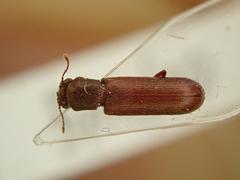 Powder Post BeetleLyctus brunneusCan damage your home
 Southern Lyctus BeetleLyctus planicollisCan damage your home
 African powderpost beetleLyctus africanusCan damage your home
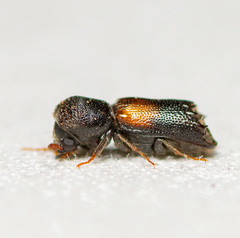 Red-shouldered BostrichidXylobiops basilaris
 Stout's Hardwood BorerPolycaon stoutiiCan damage your home
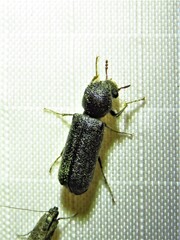 Apple Twig BorerAmphicerus bicaudatusDamages trees, gardens or crops
Sources
- Wikipedia: https://en.wikipedia.org/wiki/Rhyzopertha
Look it up elsewhere: GBIF · iNaturalist · BugGuide · ITIS · Wikipedia
Text written 2026-10-25 from the sources above and checked sentence by sentence against them. Data fetched 2026-10-25.