 Bug FAQ
Lesser Banded Hornet
Vespa affinis · Order: Hymenoptera · Family: Vespidae
Source: Wikipedia

Queens grow up to 30 mm, workers 22 to 25 mm, and the hornet is found across tropical and subtropical Asia. It builds nests in trees, shrubs or on houses and forages low on the ground for nectar, sap, fruit, carrion and other insects.
Source: Wikipedia
How to recognize it
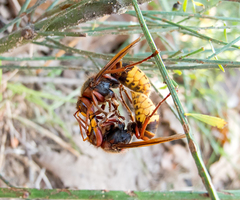
The abdomen is dark brown with the first two segments yellow-orange, sometimes reduced to spots or a narrow band.
Source: Wikipedia
Size
Queens can reach 30 mm, males about 26 mm, and workers average 22 to 25 mm.
Source: Wikipedia
Is it a pest in the house?
Nests may be built on houses, and in subtropical areas they are oval with a rounded top, while in tropical areas they are pear-shaped or drop-shaped.
Source: Wikipedia
Does it bite or sting?
It is known for aggressive behavior and a powerful sting that can cause life-threatening anaphylaxis. Seven people died from its stings in 2018.
Source: Wikipedia
Where it lives
Nests are built high in trees, low in shrubs, or on houses.
Source: Wikipedia
What it eats
It feeds on liquid foods such as flower nectar, tree sap and fruit, and also hunts bees, paper wasps and carrion.
Source: Wikipedia
Life cycle
In subtropical Hong Kong queens emerge from hibernation in April and colonies die by late November or December. In tropical areas colonies can have multiple queens founding a new nest together.
Source: Wikipedia
When you see it
In subtropical Hong Kong the species is present from April to November; in tropical regions it is present year-round.
Source: Wikipedia
Lookalikes
The species shows many regional color forms that were once considered subspecies but are now treated as informal variants.
Source: Wikipedia
Where it is found in the US
Recorded in 2 of 51 states and DC. Most records: Pennsylvania, California.
Darker = more records. Counts are museum and citizen-science records, not population size.
Source: GBIF
More photos


Questions people ask
How dangerous is the sting of Vespa affinis?
Its sting can be medically serious, causing life-threatening anaphylaxis and has caused human deaths.
Source: Wikipedia
Where does the lesser banded hornet live?
It is native to tropical and subtropical Asia, including countries such as Sri Lanka, Hong Kong, Thailand, Indonesia and Malaysia.
Source: Wikipedia
What does Vespa affinis eat?
It drinks nectar, sap and fruit juices and also preys on bees, paper wasps and carrion.
Source: Wikipedia
When are they active?
In subtropical areas they are active from April to November, while in tropical regions they are present all year.
Source: Wikipedia
Same family (Vespidae)


Sources
- Wikipedia: https://en.wikipedia.org/wiki/Vespa_affinis
Look it up elsewhere: GBIF · iNaturalist · BugGuide · Wikipedia
Text written 2026-10-23 from the sources above and checked sentence by sentence against them. Data fetched 2026-10-22.