 Bug FAQ
Lemon tree borer
Oemona hirta · Order: Coleoptera · Family: Cerambycidae
Source: Wikipedia


The larvae bore into the wood of a wide range of native and introduced trees, causing serious damage to citrus orchards and many other fruit and timber species.
Source: Wikipedia
Is it a pest in the house?
When citrus orchards were first planted in New Zealand, this beetle caused serious damage and earned the name “lemon tree borer”. Adults can be moved unintentionally with nursery stock or other plant material.
Source: Wikipedia
Where it lives
Larvae are generalist wood-borers that feed inside the trunks and branches of many tree species.
Source: Wikipedia
What it eats
Larvae attack a wide variety of trees, including citrus, apple, cherry, plum, almond, walnut, chestnut, macadamia and many ornamental species.
Source: Wikipedia
Life cycle
Females lay single white eggs about 2 mm long in leaf or stem junctions, pruning cuts, bark scars or dead twigs. The larvae are creamy-white with orange-brown gut contents and grow to 25 to 40 mm before pupating.
Source: Wikipedia
Where it comes from
The lemon tree borer is endemic to New Zealand and has not become established overseas.
Source: Wikipedia
More photos


Questions people ask
Which plants are damaged by the lemon tree borer?
Its larvae bore into the wood of many trees, especially citrus, apple, cherry, plum, almond, walnut, chestnut, macadamia and other ornamental species.
Source: Wikipedia
How does the lemon tree borer reproduce?
Females lay single white eggs about 2 mm long in leaf or stem junctions, pruning cuts, bark scars or dead twigs, and the larvae develop inside the wood.
Source: Wikipedia
Same family (Cerambycidae)
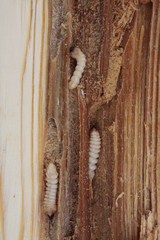 House LonghornHylotrupes bajulusCan damage your home
 Asian Longhorned BeetleAnoplophora glabripennisDamages trees, gardens or crops
 Red Milkweed BeetleTetraopes tetrophthalmus
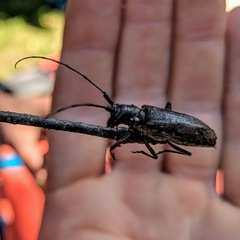 White-spotted SawyerMonochamus scutellatusCan damage your home
 Red Pine Longhorn BeetleStictoleptura rubra
 Spotted Longhorn BeetleRutpela maculataDamages trees, gardens or crops
Sources
- Wikipedia: https://en.wikipedia.org/wiki/Oemona_hirta
Look it up elsewhere: GBIF · iNaturalist · BugGuide · Wikipedia
Text written 2026-10-23 from the sources above and checked sentence by sentence against them. Data fetched 2026-10-23.