 Bug FAQ
Large Rose Sawfly
Arge pagana · Order: Hymenoptera · Family: Argidae
Also called: Common Rose Fusehorn
Source: Wikipedia


Adults are about 1 cm long with black wings that can show a blue metallic sheen and a large rounded yellow abdomen. The gregarious larvae grow to about 25 mm and strip the foliage of roses in early summer.
Source: Wikipedia
How to recognize it
The wings are black with a metallic blue shine and the abdomen is a conspicuous rounded yellow.
Source: Wikipedia
Size
Adults reach roughly 1 cm in length. Larvae grow to about 25 mm before pupating.
Source: Wikipedia
Is it a pest in the house?
Eggs laid on roses lead to larvae that feed together on rose foliage, potentially harming garden roses.
Source: Wikipedia
Where it lives
Eggs are deposited on rose plants, and the species is commonly called the large rose sawfly.
Source: Wikipedia
What it eats
Larvae live in colonies and eat the leaves of rose species such as Rosa and Rosa acicularis. Adults sip nectar and pollen from plants like tansy (Tanacetum vulgare) and hogweed (Heracleum sphondylium).
Source: Wikipedia
Life cycle
The pupal stage is very brief. In warm years the species may produce two, occasionally three, generations per year.
Source: Wikipedia
Where it comes from
It occurs throughout the Palearctic region.
Source: Wikipedia
Lookalikes
The related species Arge ochropus is also sometimes called the large rose sawfly.
Source: Wikipedia
More photos


Questions people ask
When are the larvae present?
Larvae show up in early summer and are fully grown by late July.
Source: Wikipedia
How can I identify this sawfly?
Look for black wings with a blue metallic sheen and a large rounded yellow abdomen.
Source: Wikipedia
Same family (Argidae)
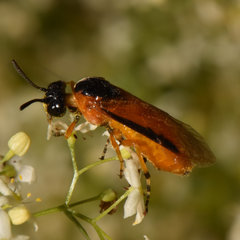 Rose SawflyArge ochropusDamages trees, gardens or crops
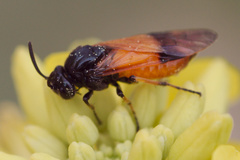 Bramble SawflyArge cyanocroceaDamages trees, gardens or crops
 Azalea Argid SawflyArge similis
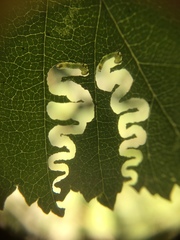 Elm Zigzag SawflyAproceros leucopodaDamages trees, gardens or crops
 Cibdela janthinaCibdela janthina
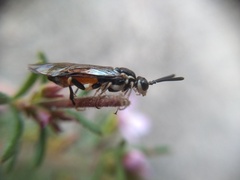 Zenarge turneriZenarge turneriDamages trees, gardens or crops
Sources
- Wikipedia: https://en.wikipedia.org/wiki/Arge_pagana
Look it up elsewhere: GBIF · iNaturalist · BugGuide · Wikipedia
Text written 2026-10-23 from the sources above and checked sentence by sentence against them. Data fetched 2026-10-22.