 Bug FAQ
Rose Sawfly
Arge ochropus · Order: Hymenoptera · Family: Argidae
Also called: Argid sawfly, Wild Rose Fusehorn
Source: Wikipedia
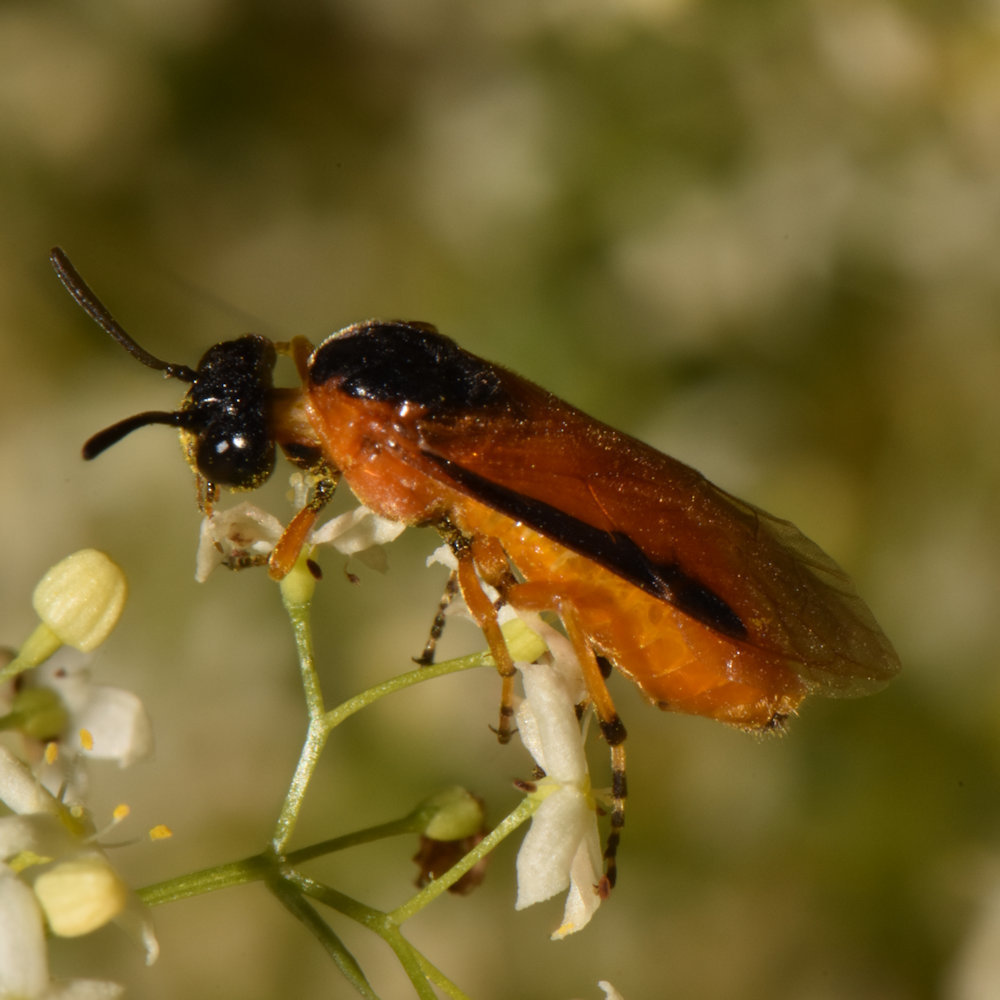
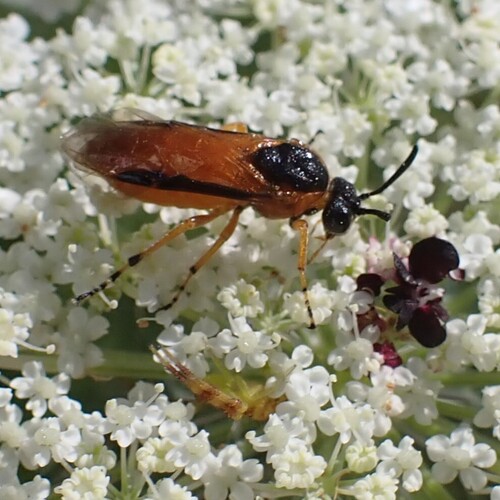
Adults are 7 to 10 mm long with a black head and thorax and reddish-orange abdomen and wings. It has two generations each year and females lay about 16 to 18 eggs on rose stems.
Source: Wikipedia
How to recognize it
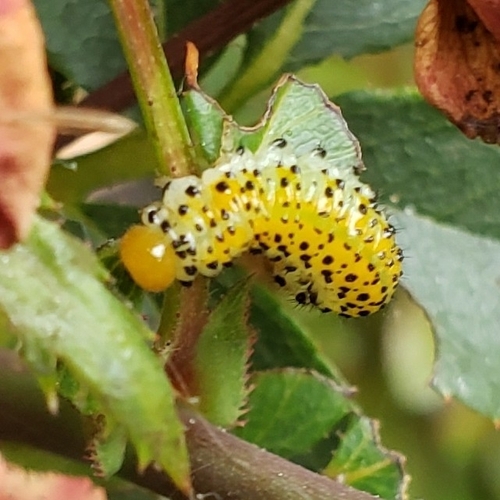
Larvae are yellow, bristly and show black markings.
Source: Wikipedia
Size
Adults grow to 7 to 10 mm (0.28 to 0.39 in) in length.
Source: Wikipedia
What it eats
Adults feed on nectar and pollen from tansy, wild angelica and hogweed. Larvae eat the leaves of rose species such as dog rose, meadow rose and burnet rose.
Source: Wikipedia
Life cycle
The species produces two generations per year. Females lay about 16 to 18 eggs on rose stems.
Source: Wikipedia
Lookalikes
It resembles Athalia rosae, but its antennae have three segments with a greatly elongated third segment, unlike the 10 to 11 segmented antennae of Athalia rosae. Arge pagana, a related species, is mainly black on the upper side.
Source: Wikipedia
Where it is found in the US
Recorded in 9 of 51 states and DC. Most records: Michigan, New York, Ohio, Illinois, Massachusetts, Vermont, Pennsylvania, Maine.
Darker = more records. Counts are museum and citizen-science records, not population size.
Source: GBIF
Status: introduced in Canada; introduced in United States. Source: iNaturalist
Months it is reported in the US
Source: GBIF
More photos
Questions people ask
What do rose sawfly larvae eat?
The larvae feed on the leaves of various rose species.
Source: Wikipedia
How many generations does the rose sawfly have each year?
It has two generations per year.
Source: Wikipedia
How can I tell the rose sawfly apart from similar species?
Its antennae have three segments with a long third segment, unlike the many-segmented antennae of Athalia rosae, and it is not mainly black like Arge pagana.
Source: Wikipedia
Same family (Argidae)

Sources
- Wikipedia: https://en.wikipedia.org/wiki/Arge_ochropus
Look it up elsewhere: GBIF · iNaturalist · BugGuide · Wikipedia
Text written 2026-10-22 from the sources above and checked sentence by sentence against them. Data fetched 2026-10-22.