 Bug FAQ
Bramble Sawfly
Arge cyanocrocea · Order: Hymenoptera · Family: Argidae
Also called: Broad-barred Fusehorn
Source: Wikipedia
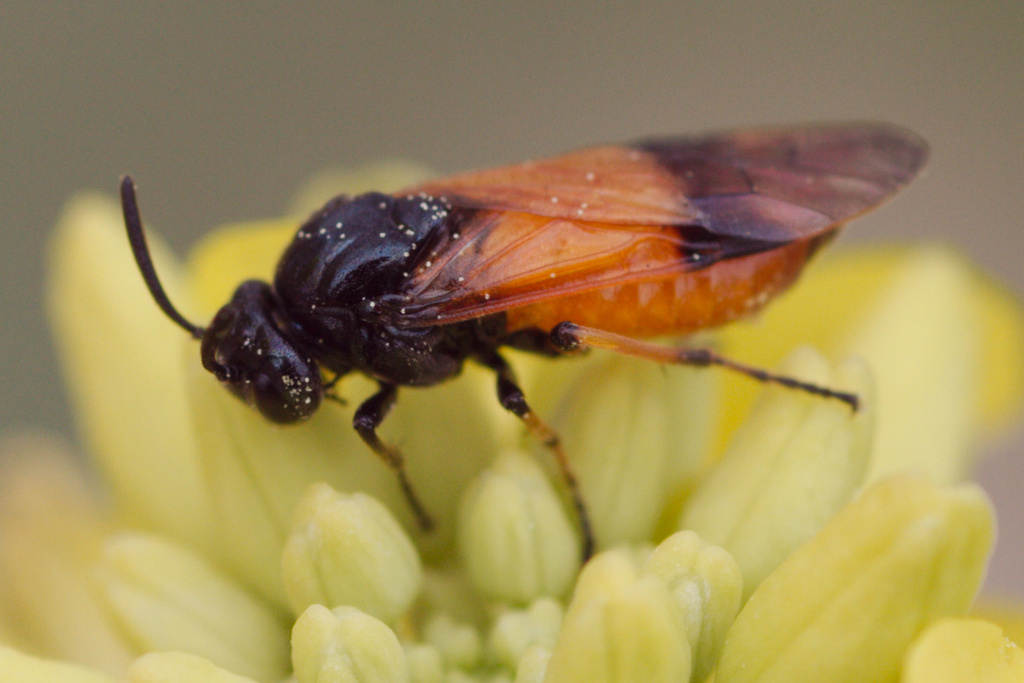
Adults are tiny, about 7 to 8 mm long, with a black head and thorax and a yellow-orange abdomen. They are seen from May to July and eat pollen, nectar, and the leaves of brambles.
Source: Wikipedia
How to recognize it
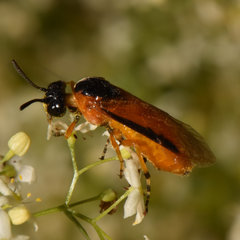
The head and thorax are black, the abdomen is yellow-orange, and the wings have a wide dark band with a gray tip.
Source: Wikipedia
Size
Adults grow to about 7 to 8 mm (0.28 to 0.31 in) long.
Source: Wikipedia
Where it lives
They visit flowers of Apiaceae, Euphorbiaceae and Asteraceae from May to July. Larvae feed on the leaves of brambles such as blackberry, raspberry and great burnet.
Source: Wikipedia
What it eats
Adults sip pollen and nectar from various Apiaceae, Euphorbiaceae and Asteraceae plants. Larvae chew the leaves of blackberry, raspberry and great burnet.
Source: Wikipedia
Life cycle
Larvae look like caterpillars but have five pairs of prolegs instead of four. Adults are present from May through July.
Source: Wikipedia
When you see it
They can be encountered from May to July.
Source: Wikipedia
Where it comes from
They occur across most of Europe, the Caucasus, Asia Minor and Japan.
Source: Wikipedia
Lookalikes
It resembles Arge pagana, which has black wings.
Source: Wikipedia
Same family (Argidae)

Sources
- Wikipedia: https://en.wikipedia.org/wiki/Arge_cyanocrocea
Look it up elsewhere: GBIF · iNaturalist · BugGuide · Wikipedia
Text written 2026-10-23 from the sources above and checked sentence by sentence against them. Data fetched 2026-10-22.