 Bug FAQ
Indian Red Scorpion
Hottentotta tamulus · Order: Scorpiones · Family: Buthidae
Source: Wikipedia


Adults are 5 to 9 cm long and have orange-yellow legs and pincers. They live in humid lowland areas of India, eastern Pakistan, eastern Nepal and Sri Lanka, often near villages and rural homes. The scorpion is nocturnal, hunting insects and small vertebrates, and it may crawl into beds or fall from ceilings at night.
Source: Wikipedia
How to recognize it
Each body segment on the back has three distinct ridges.
Source: Wikipedia
Size
Total body length ranges from about 50 to 90 mm.
Source: Wikipedia
Is it a pest in the house?
It often lives near or inside human settlements, especially in rural areas, and may enter homes at night.
Source: Wikipedia
Does it bite or sting?
The venom primarily attacks the cardiovascular and pulmonary systems, leading to pulmonary oedema that can cause death.
Source: Wikipedia
How to get rid of it
Medical treatment usually includes the drug prazosin, which can lower the rising blood pressure caused by the sting.
Source: Wikipedia
Where it lives
It is common in vegetated lowlands with a humid subtropical to tropical climate and often lives close to human settlements, especially in rural areas. It is rarely found under tree bark, where its sister species H. pachyurus dominates.
Source: Wikipedia
What it eats
Like other scorpions, it is nocturnal and preys on small invertebrates and even small vertebrates such as lizards.
Source: Wikipedia
When you see it
Human encounters usually happen at night or early morning when the scorpion accidentally crawls into beds or falls from ceilings.
Source: Wikipedia
Where it comes from
It occurs throughout most of India, eastern Pakistan, the eastern lowlands of Nepal and has recently been recorded in Sri Lanka.
Source: Wikipedia
Lookalikes
In a study of six scorpion species, it was the most abundant, making up about 48 % of captures. It is seldom found under tree bark, where H. pachyurus is far more common.
Source: Wikipedia
More photos


Questions people ask
How dangerous is a sting from the Indian Red Scorpion?
A sting can be medically serious, affecting the heart and lungs and may be fatal.
Source: Wikipedia
What drug is used to treat a sting?
Prazosin is commonly given to reduce the high blood pressure caused by the venom.
Source: Wikipedia
Where does this scorpion live?
It is found across most of India, eastern Pakistan, eastern Nepal and recently in Sri Lanka, especially in humid lowland areas near villages.
Source: Wikipedia
When are people most likely to encounter it?
Encounters usually happen at night or early morning when the scorpion may crawl into beds or fall from ceilings.
Source: Wikipedia
Same family (Buthidae)
 Striped Bark ScorpionCentruroides vittatusCan sting
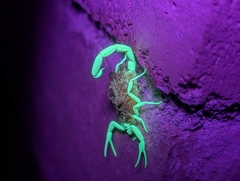 Arizona Bark ScorpionCentruroides sculpturatusVenomous
 Slender Brown ScorpionCentruroides gracilisVenomous
 Edward's Bark ScorpionCentruroides edwardsiiVenomous
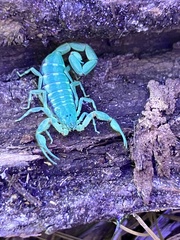 Hentz Striped ScorpionCentruroides hentziCan sting
 Common Yellow ScorpionButhus occitanusVenomous
Sources
- Wikipedia: https://en.wikipedia.org/wiki/Hottentotta_tamulus
Look it up elsewhere: GBIF · iNaturalist · BugGuide · Wikipedia
Text written 2026-10-23 from the sources above and checked sentence by sentence against them. Data fetched 2026-10-23.