 Bug FAQ
Greater Banded Hornet
Vespa tropica · Order: Hymenoptera · Family: Vespidae
Source: Wikipedia
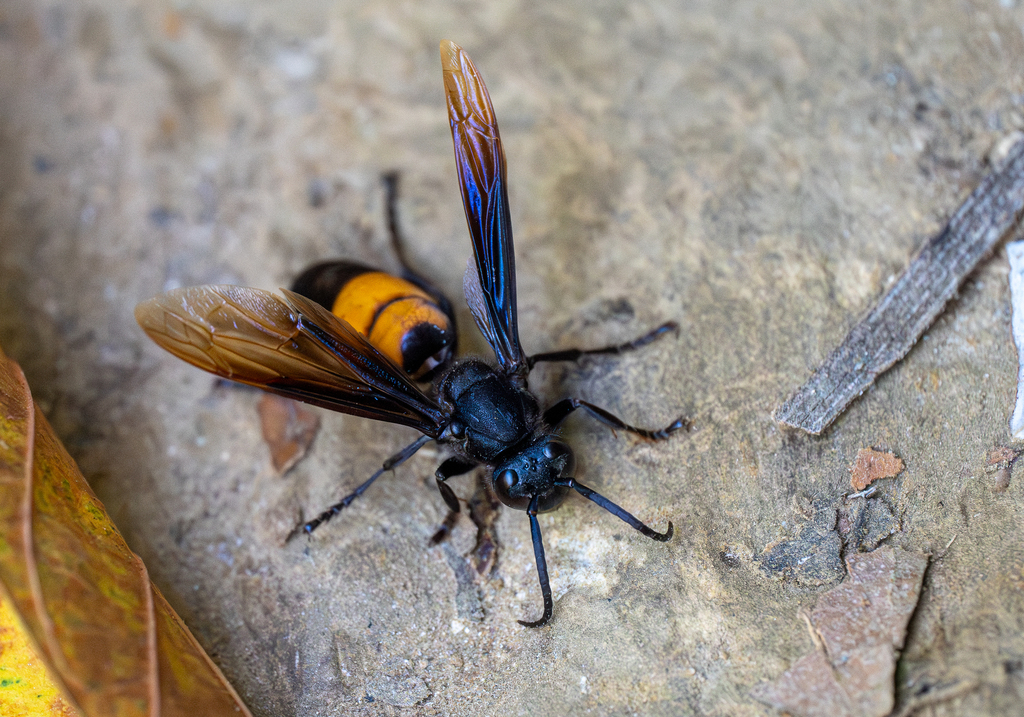
Workers are about 24 to 26 mm long and queens reach about 30 mm; the head is dark brown-red and the abdomen is black with a yellow stripe on the second segment. It nests in lowland forests up to 2,100 m and also builds nests under roofs, in attics and sheds near human homes.
Source: Wikipedia
How to recognize it
The head is dark brown or red, and the abdomen is black with a prominent yellow stripe covering most of the second segment. In Singapore and SE Asia some individuals are completely black and larger, while in Hong Kong the head and thorax flanks are usually reddish.
Source: Wikipedia
Size
Workers measure about 24 to 26 mm (roughly 1 in) in length; queens grow to about 30 mm (1¼ in).
Source: Wikipedia
Is it a pest in the house?
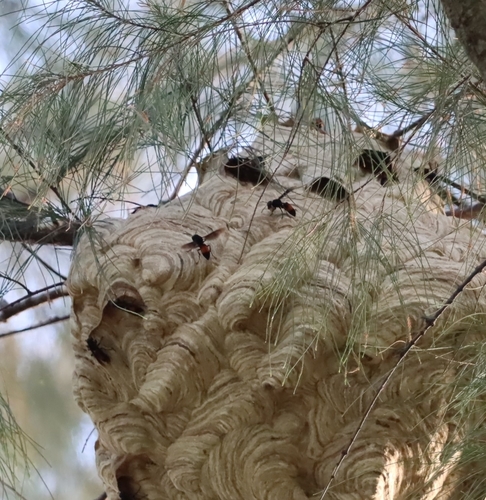
It can nest under roofs, in attics and sheds, often staying close to cover and high in tree crowns.
Source: Wikipedia
How to get rid of it
It was found on Guam in 2016 and is now considered a permanent resident until eradication methods are developed.
Source: Wikipedia
Where it lives
It is associated with lowland forests up to 2,100 m altitude.
Source: Wikipedia
What it eats
It raids nests of other wasps, taking captured larvae back to its own nest to feed its young. It frequently catches honeybees and has even been observed preying on dragonflies.
Source: Wikipedia
Life cycle
Nest temperature is kept at 25 to 30 °C until mid-October, after which it drops toward ambient as the nest dies.
Source: Wikipedia
When you see it
The nest maintains a warm temperature until about mid-October, then the colony declines.
Source: Wikipedia
Lookalikes
It belongs to the V. tropica group together with V. ducalis and V. philippinensis.
Source: Wikipedia
More photos
Questions people ask
How dangerous is the sting of a Greater Banded Hornet?
Its sting is potent and can cause extreme pain and swelling.
Source: Wikipedia
Where does this hornet usually build its nest?
It nests in lowland forests up to 2,100 m and also under roofs, in attics and sheds near homes.
Source: Wikipedia
What does the Greater Banded Hornet eat?
It raids other wasp nests for larvae and also catches honeybees and dragonflies.
Source: Wikipedia
Is this species found in Australia?
No, it has not been recorded on mainland Australia.
Source: Wikipedia
Same family (Vespidae)


Sources
- Wikipedia: https://en.wikipedia.org/wiki/Vespa_tropica
Look it up elsewhere: GBIF · iNaturalist · BugGuide · Wikipedia
Text written 2026-10-23 from the sources above and checked sentence by sentence against them. Data fetched 2026-10-22.