 Bug FAQ
Great capricorn beetle
Cerambyx cerdo · Order: Coleoptera · Family: Cerambycidae
Also called: Greater Capricorn Beetle, Cerambyx Longicorn
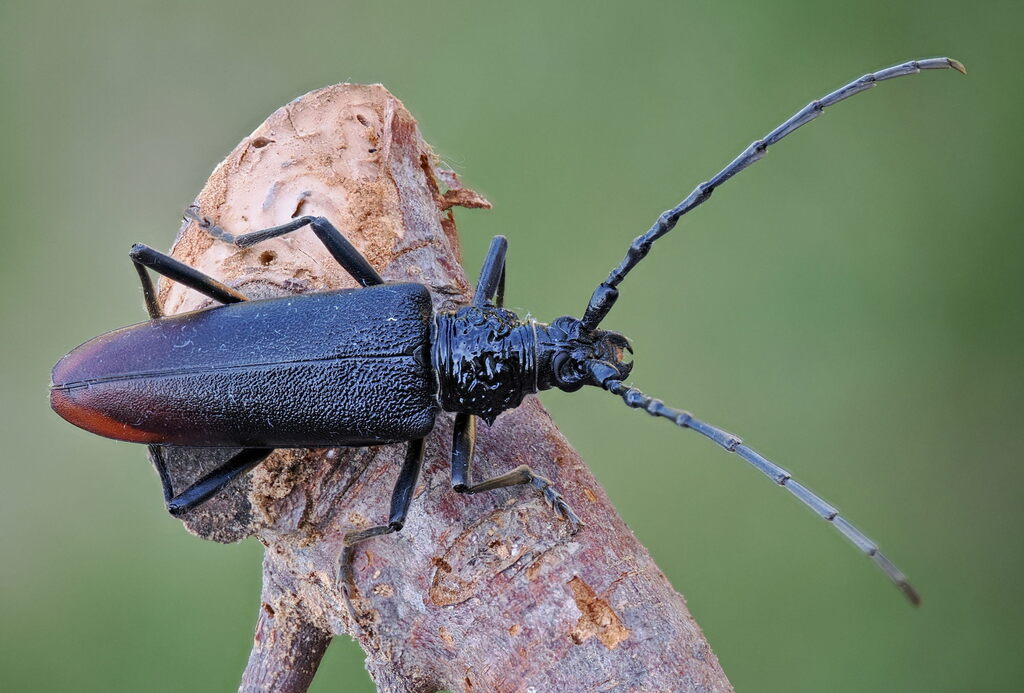
The great capricorn beetle is a large longhorn beetle measuring about 41 to 55 mm in length. It has a sturdy, elongated body that is black except for reddish-brown tips on the wing covers, and it bears long antennae. Its native range includes North Africa, much of Europe, and parts of West Asia.
Source: Wikipedia
How to recognize it
The beetle is black with reddish-brown tips on the elytra and has long antennae typical of longhorns.
Source: Wikipedia
Size
Adults are 41 to 55 mm long.
Source: Wikipedia
Where it comes from
It occurs in North Africa (Algeria, Morocco, Tunisia), many European countries, and West Asian nations such as Armenia and Turkey.
Source: Wikipedia
More photos
Questions people ask
How large does the great capricorn beetle get?
Adults range from about 41 to 55 mm in length.
Source: Wikipedia
What does the great capricorn beetle look like?
It has a robust, elongated black body with reddish-brown tips on the wing covers and long antennae.
Source: Wikipedia
Where is the great capricorn beetle found?
It is native to North Africa, most of Europe, and parts of West Asia.
Source: Wikipedia
Same family (Cerambycidae)
 House LonghornHylotrupes bajulusCan damage your home
 Asian Longhorned BeetleAnoplophora glabripennisDamages trees, gardens or crops
 Red Milkweed BeetleTetraopes tetrophthalmus
 White-spotted SawyerMonochamus scutellatusCan damage your home
 Red Pine Longhorn BeetleStictoleptura rubra
 Spotted Longhorn BeetleRutpela maculataDamages trees, gardens or crops
Sources
- Wikipedia: https://en.wikipedia.org/wiki/Cerambyx_cerdo
Look it up elsewhere: GBIF · iNaturalist · BugGuide · Wikipedia
Text written 2026-10-22 from the sources above and checked sentence by sentence against them. Data fetched 2026-10-22.