 Bug FAQ
Grape Wood Borer
Chlorophorus varius · Order: Coleoptera · Family: Cerambycidae

The grape wood borer is an elongated beetle whose colour and markings vary widely and it is covered with a yellow-greenish fuzz. Adults are 8 to 14 mm long, while the larvae grow to about 15 mm. It lives on sunny meadow edges and woodland borders from low to mid elevations, and the adults are seen from May through September.
Source: Wikipedia
How to recognize it
The beetle’s body is long and its colour and pattern change a lot, which is why its name means “varied”. It is covered with a yellow-greenish fine hair, sometimes appearing gray or white.
Source: Wikipedia
Size
Adults reach 8 to 14 mm in length. The larvae can grow to about 15 mm long.
Source: Wikipedia
Where it lives
They prefer sunny meadows and the edges of woodlands, from 60 to 800 m above sea level.
Source: Wikipedia
What it eats
Adults feed on pollen and nectar of many flowers, especially those in the carrot family. Larvae live in dead wood and branches of deciduous trees and shrubs such as grape, maple, oak, poplar, apple and hawthorn, and sometimes in conifers.
Source: Wikipedia
Life cycle
The whole life cycle takes two to three years. Pupation occurs in the spring inside the wood where the larvae develop.
Source: Wikipedia
Where it comes from
The species occurs throughout most of Europe (except the far north), the Caucasus, Turkey, northern Iran and the Near East.
Source: Wikipedia
More photos


Questions people ask
What does the grape wood borer look like?
It is an elongated beetle with highly variable colours and markings, covered in a yellow-greenish fuzz that can also appear gray or white.
Source: Wikipedia
How big are the adults and larvae?
Adults are 8 to 14 mm long, while the larvae grow to about 15 mm.
Source: Wikipedia
Where do they live?
They live in sunny meadow edges and woodland borders across most of Europe, the Caucasus, Turkey, northern Iran and the Near East.
Source: Wikipedia
Same family (Cerambycidae)
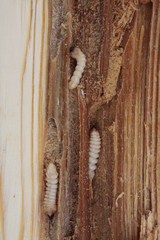 House LonghornHylotrupes bajulusCan damage your home
 Asian Longhorned BeetleAnoplophora glabripennisDamages trees, gardens or crops
 Red Milkweed BeetleTetraopes tetrophthalmus
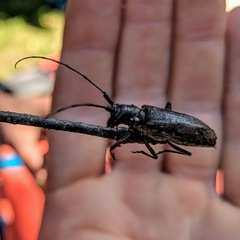 White-spotted SawyerMonochamus scutellatusCan damage your home
 Red Pine Longhorn BeetleStictoleptura rubra
 Spotted Longhorn BeetleRutpela maculataDamages trees, gardens or crops
Sources
- Wikipedia: https://en.wikipedia.org/wiki/Chlorophorus_varius
Look it up elsewhere: GBIF · iNaturalist · BugGuide · Wikipedia
Text written 2026-10-23 from the sources above and checked sentence by sentence against them. Data fetched 2026-10-22.