 Bug FAQ
Golden-bloomed Longhorn Beetle
Agapanthia villosoviridescens · Order: Coleoptera · Family: Cerambycidae
Source: Wikipedia
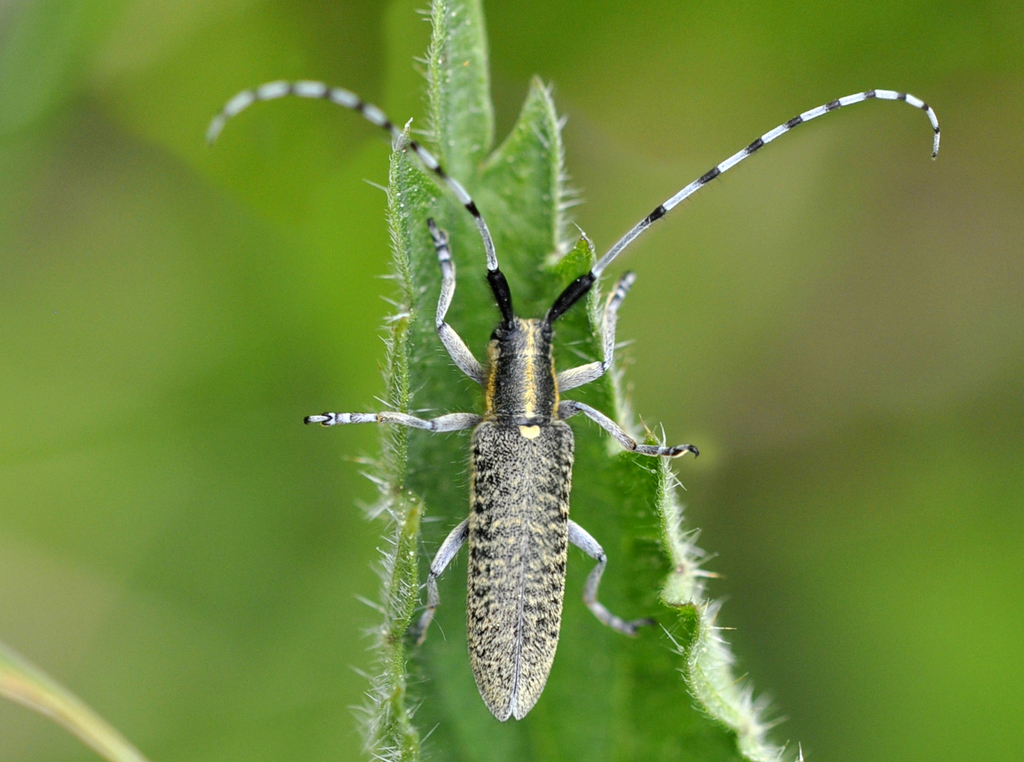
Adults are small, golden-black longhorn beetles that fly from late spring to summer. The larvae develop inside a wide range of herbaceous plants, cutting off the stalk and pupating near the ground. They are found across Europe and parts of Asia, including the Caucasus, Kazakhstan and Turkey.
Source: Wikipedia
How to recognize it
It has a golden-black colour with a golden sheen on the wing covers and thorax. The body is slim, cylindrical and grey-yellow over black.
Source: Wikipedia
Size
The beetle measures between 10 and 22 mm long.
Source: Wikipedia
Where it lives
Adults are on the wing from May through August.
Source: Wikipedia
What it eats
Larvae feed inside the stalks of many host plants, cutting the stalk and forming pupal cells near ground level. Adults leave the stalk by cutting a new exit hole in its side.
Source: Wikipedia
Life cycle
The species uses many different host plants for its larval stage. When ready, adults emerge through a freshly cut hole in the side of the stalk.
Source: Wikipedia
When you see it
Their flight period runs from May to August.
Source: Wikipedia
Lookalikes
It looks similar to the small aspen longhorn Saperda populnea but is noticeably slimmer.
Source: Wikipedia
More photos


Questions people ask
Do these beetles damage garden plants?
Yes, the larvae bore into the stalks of many garden and crop plants, which can kill or weaken the plants.
Source: Wikipedia
When can I see adult beetles?
Adults are active and can be seen flying from May through August.
Source: Wikipedia
How can I tell this beetle apart from similar species?
It is slimmer than the small aspen longhorn and has a much narrower pronotum compared to its wing covers.
Source: Wikipedia
Same family (Cerambycidae)
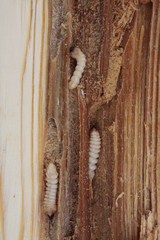 House LonghornHylotrupes bajulusCan damage your home
 Asian Longhorned BeetleAnoplophora glabripennisDamages trees, gardens or crops
 Red Milkweed BeetleTetraopes tetrophthalmus
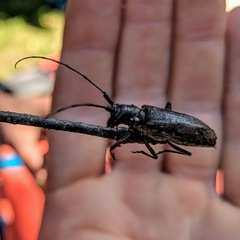 White-spotted SawyerMonochamus scutellatusCan damage your home
 Red Pine Longhorn BeetleStictoleptura rubra
 Spotted Longhorn BeetleRutpela maculataDamages trees, gardens or crops
Sources
- Wikipedia: https://en.wikipedia.org/wiki/Agapanthia_villosoviridescens
Look it up elsewhere: GBIF · iNaturalist · BugGuide · Wikipedia
Text written 2026-10-22 from the sources above and checked sentence by sentence against them. Data fetched 2026-10-22.