 Bug FAQ
Glassy-winged Sharpshooter
Homalodisca vitripennis · Order: Hemiptera · Family: Cicadellidae
Source: Wikipedia

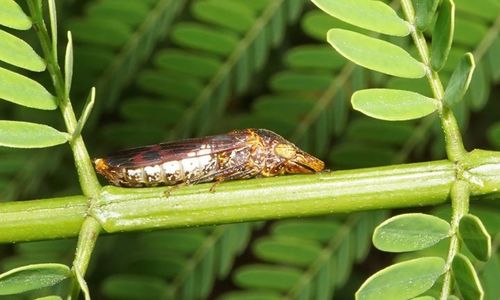
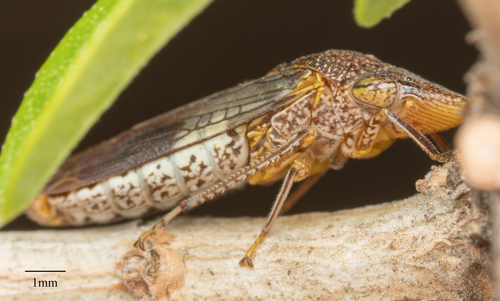
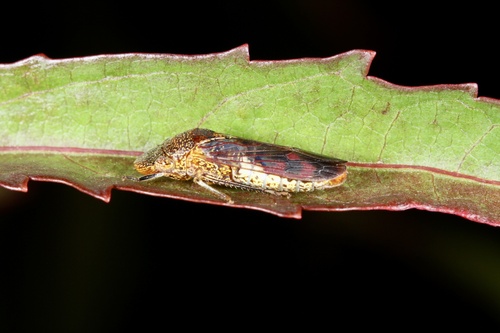
These insects are about 12 mm long, dark brown to black with yellow eyes and speckled ivory spots on the head and back, and have transparent wings with reddish veins. They feed on many kinds of plants by piercing the xylem, and their feeding and excrement rarely cause serious plant damage, though they can spread disease to crops and garden plants.
Source: Wikipedia
How to recognize it
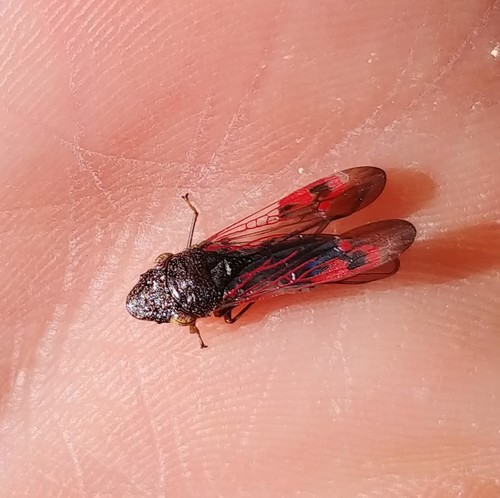
The bug is dark brown to black, has yellow eyes, and ivory-yellow spots on the head and back. Its wings are clear with reddish veins.
Source: Wikipedia
Size
It measures roughly 12 mm (about half an inch) in length.
Source: Wikipedia
Is it a pest in the house?
Their feeding and the droppings called “sharpshooter rain” rarely cause serious plant damage.
Source: Wikipedia
How to get rid of it
Biological control is the main strategy, so avoid broad-spectrum insecticides that could kill helpful parasitoids and predators. The primary reason to control it is to stop the spread of Xylella fastidiosa to vulnerable plants.
Source: Wikipedia
Where it lives
It feeds by inserting needle-like mouthparts into plant xylem. Because it can use many host plants, it thrives in both farms and city gardens.
Source: Wikipedia
What it eats
It eats a wide variety of plants, always tapping the xylem with its mouthparts.
Source: Wikipedia
Life cycle
Females lay egg masses on leaf undersides and cover them with a powdery white secretion called brochosomes. After several molts the nymphs become adult sharpshooters.
Source: Wikipedia
When you see it
Beneficial insects like assassin bugs, mantids, spiders, lacewings, and parasitic wasps can help control them. Parasitoid wasps cause low parasitism early in the year (10-50 %) but can reach up to 90 % mortality by late summer or early fall.
Source: Wikipedia
Where it comes from
The species is native to the southeastern United States.
Source: Wikipedia
Lookalikes
It is a large leafhopper in the family Cicadellidae, similar to other sharpshooter species.
Source: Wikipedia
Where it is found in the US
Recorded in 15 of 51 states and DC. Most records: Texas, California, Louisiana, North Carolina, Alabama, Georgia, Mississippi, Florida.
Darker = more records. Counts are museum and citizen-science records, not population size.
Source: GBIF
Months it is reported in the US
Source: GBIF
More photos
Questions people ask
Can they damage my garden?
They feed on many garden plants and can spread a plant disease, but their feeding usually causes only minor damage.
Source: Wikipedia
Same family (Cicadellidae)
 Red-banded LeafhopperGraphocephala coccineaDamages trees, gardens or crops
 Coppery LeafhopperJikradia olitoria
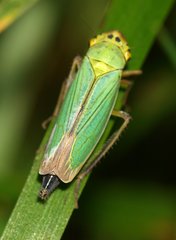 Green LeafhopperCicadella viridis
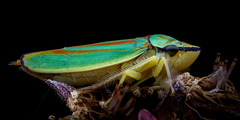 Rhododendron LeafhopperGraphocephala fennahiDamages trees, gardens or crops
 Japanese LeafhopperOrientus ishidaeCan spread germs or disease
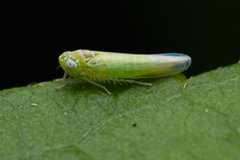 Potato LeafhopperEmpoasca fabaeDamages trees, gardens or crops
Sources
- Wikipedia: https://en.wikipedia.org/wiki/Glassy-winged_sharpshooter
Look it up elsewhere: GBIF · iNaturalist · BugGuide · Wikipedia
Text written 2026-10-22 from the sources above and checked sentence by sentence against them. Data fetched 2026-10-22.