 Bug FAQ
Giant Longhorn
Tithoes confinis · Order: Coleoptera · Family: Cerambycidae
Source: Wikipedia
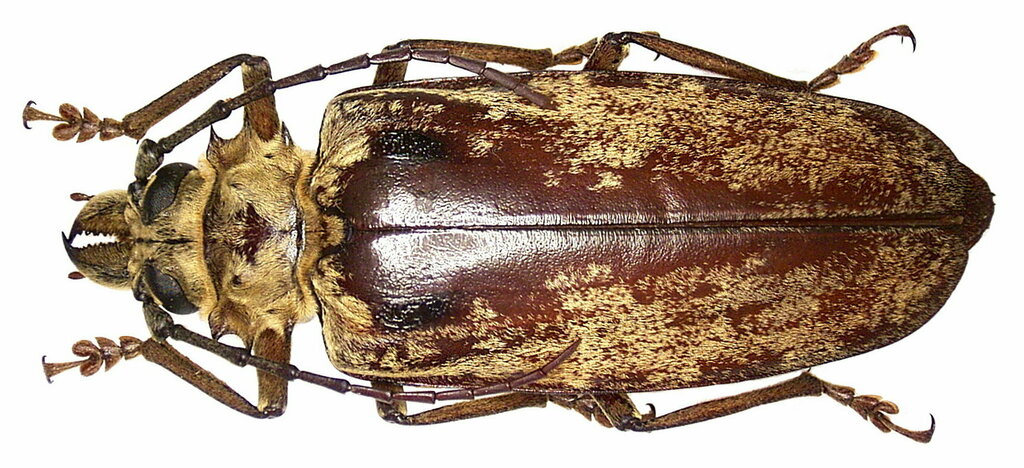
Adults are dark brown, heavily hairy beetles with strong mandibles and grow up to about 10 cm long. They live in forested areas across much of the Afrotropical region and are active at night. The larvae feed on cashew trees and other Anacardiaceae, which can harm those plants.
Source: Wikipedia
How to recognize it
Its basic colour is dark brown.
Source: Wikipedia
Size
It can reach a length of about 55 to 100 mm (2.2 to 3.9 in).
Source: Wikipedia
Where it lives
It is found in forests throughout most of the continental Afrotropics.
Source: Wikipedia
What it eats
Larvae feed on cashew nut trees and other trees in the Anacardiaceae family.
Source: Wikipedia
Life cycle
The larvae develop by feeding on cashew and related trees.
Source: Wikipedia
When you see it
Adults are active at night.
Source: Wikipedia
Questions people ask
What do the larvae of the Giant Longhorn eat?
They feed on cashew trees and other members of the Anacardiaceae family.
Source: Wikipedia
Are Giant Longhorn beetles active during the day or night?
Adults are nocturnal and are active at night.
Source: Wikipedia
How large can a Giant Longhorn beetle get?
They can grow up to about 10 cm (100 mm) in length.
Source: Wikipedia
Same family (Cerambycidae)
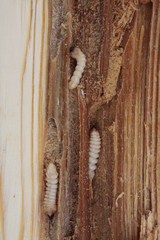 House LonghornHylotrupes bajulusCan damage your home
 Asian Longhorned BeetleAnoplophora glabripennisDamages trees, gardens or crops
 Red Milkweed BeetleTetraopes tetrophthalmus
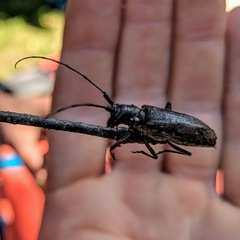 White-spotted SawyerMonochamus scutellatusCan damage your home
 Red Pine Longhorn BeetleStictoleptura rubra
 Spotted Longhorn BeetleRutpela maculataDamages trees, gardens or crops
Sources
- Wikipedia: https://en.wikipedia.org/wiki/Tithoes_confinis
Look it up elsewhere: GBIF · iNaturalist · BugGuide · Wikipedia
Text written 2026-10-23 from the sources above and checked sentence by sentence against them. Data fetched 2026-10-23.