 Bug FAQ
Giant Bamboo Ladybird
Synonycha grandis · Order: Coleoptera · Family: Coccinellidae
Also called: Lady beetle
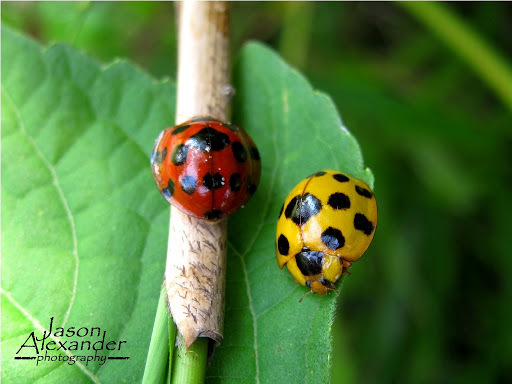
The giant bamboo ladybird is about 13 mm long, hemispherical, and females are larger than males. It is a bright red-yellow beetle with black spots on the wing covers and black with yellow spots on the thorax. It lives in Australia, Oceania and southern Asia and is also recorded in the United States and Hawaii.
Source: Wikipedia
How to recognize it
The wing covers are yellowish to red and bear black spots. The back is black with yellow spots on the middle and rear thorax.
Source: Wikipedia
Size
Adults are about 13 mm long and have a hemispherical shape. Females are larger than males.
Source: Wikipedia
Does it bite or sting?
When disturbed it releases a foul-smelling yellow fluid.
Source: Wikipedia
Where it lives
It hunts voraciously on bamboo, feeding on many bamboo-aphid species.
Source: Wikipedia
What it eats
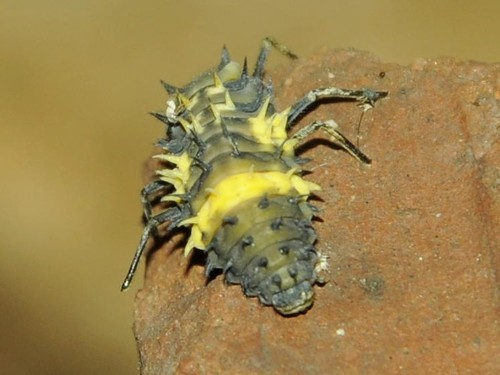
It preys on bamboo aphids like Pseudoregma bambucicola, Aphis craccivora and others. Second-instar larvae begin moving and feeding on aphid nymphs and adults.
Source: Wikipedia
Life cycle
Mating takes place one day after the adults emerge. Newly emerged adults are golden yellow with soft forewings.
Source: Wikipedia
Where it comes from
It is also native to Australia, Oceania and southern Asian countries such as China, India, Japan and the Philippines.
Source: Wikipedia
More photos
Questions people ask
What does the giant bamboo ladybird look like?
Its wing covers are yellow-red with black spots and the back is black with yellow spots on the middle and rear thorax.
Source: Wikipedia
What does it eat?
It feeds on a range of bamboo aphids, and its larvae also eat aphid nymphs and adults.
Source: Wikipedia
Where is this beetle found?
It is present in the United States and Hawaii, and also native to Australia, Oceania and many southern Asian countries.
Source: Wikipedia
Same family (Coccinellidae)

Sources
- Wikipedia: https://en.wikipedia.org/wiki/Synonycha
Look it up elsewhere: GBIF · iNaturalist · BugGuide · ITIS · Wikipedia
Text written 2026-10-23 from the sources above and checked sentence by sentence against them. Data fetched 2026-10-23.