 Bug FAQ
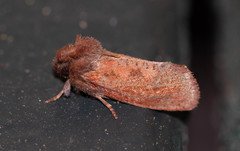
Fungus moth
Erechthias simulans · Order: Lepidoptera · Family: Tineidae
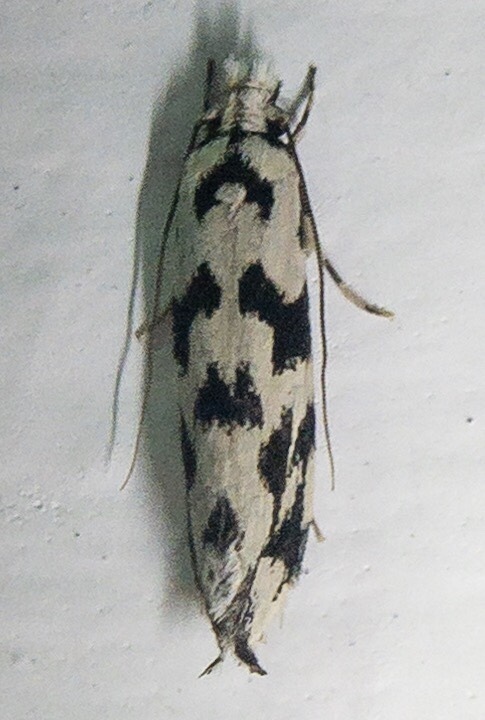
The moth has a wingspan of about 15 to 20 mm (roughly two-thirds of an inch). Pupation occurs in a tough cocoon inside the tunnel the caterpillar creates, and the pupa is about 10 mm long.
Source: Wikipedia
How to recognize it
Males have a broad, stubby harpe with a bristled swelling and a toothed cucullus edge; the uncus is slightly hardened on the sides and split at the tip. Females have a narrow, U-shaped ostium and a tubular, sclerotized antrum; the bursa copulatrix has a mesh of fine ridges and a sickle-shaped signum.
Source: Wikipedia
Size
The adult’s wingspan ranges from 15 to 20 mm.
Source: Wikipedia
Where it lives
On larger islands the species tends to be found near the coast.
Source: Wikipedia
What it eats
Caterpillars eat dead and decaying stems, bark and outer wood of many core eudicots.
Source: Wikipedia
Life cycle
The larva builds a tunnel in the dead stem, pupates in a tough cocoon inside that tunnel, and the pupa measures about 10 mm.
Source: Wikipedia
Where it comes from
Its original distribution is unclear, but it likely spread with human transport of its food plants.
Source: Wikipedia
Lookalikes
It has been confused with species of the related genus Comodica, but modern authors no longer place it there.
Source: Wikipedia
Where it is found in the US
Recorded in 1 of 51 states and DC. Most records: Hawaii.
Darker = more records. Counts are museum and citizen-science records, not population size.
Source: GBIF
Months it is reported in the US
Source: GBIF
More photos
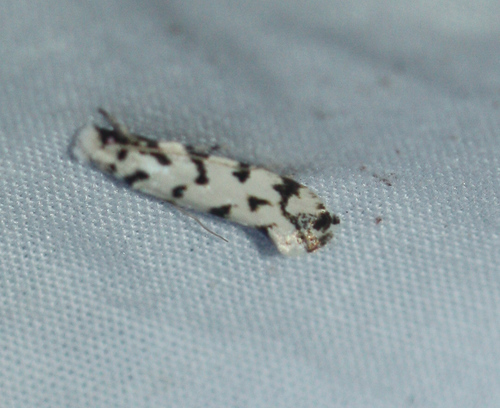
Questions people ask
What do the caterpillars eat?
They feed on dead and decaying plant stems, especially bark and outer wood of many eudicot trees.
Source: Wikipedia
Where is this moth usually found?
On larger islands it is often found near the coast.
Source: Wikipedia
How can I tell it apart from similar moths?
Its male genitalia have a broad, stubby harpe with bristles and a toothed cucullus edge, and it is no longer classified in the genus Comodica.
Source: Wikipedia
Same family (Tineidae)
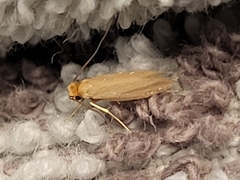 Webbing Clothes MothTineola bisselliellaCan damage your home
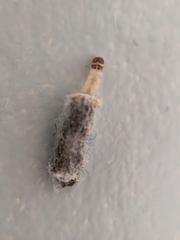 Case-bearing Clothes MothTinea pellionellaCan damage your home
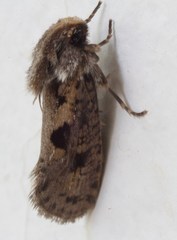 Clemens' Grass Tubeworm MothAcrolophus popeanella
 Eastern Grass Tubeworm MothAcrolophus plumifrontella
 Household CasebearerPhereoeca uterellaCan damage your home
 Arcane Grass Tubeworm MothAcrolophus arcanella
Sources
- Wikipedia: https://en.wikipedia.org/wiki/Erechthias_simulans
Look it up elsewhere: GBIF · iNaturalist · BugGuide · Wikipedia
Text written 2026-10-29 from the sources above and checked sentence by sentence against them. Data fetched 2026-10-29.