 Bug FAQ
Fringed Larder Beetle
Dermestes frischi · Order: Coleoptera · Family: Dermestidae
Also called: Frisch's carpet beetle
Source: Wikipedia
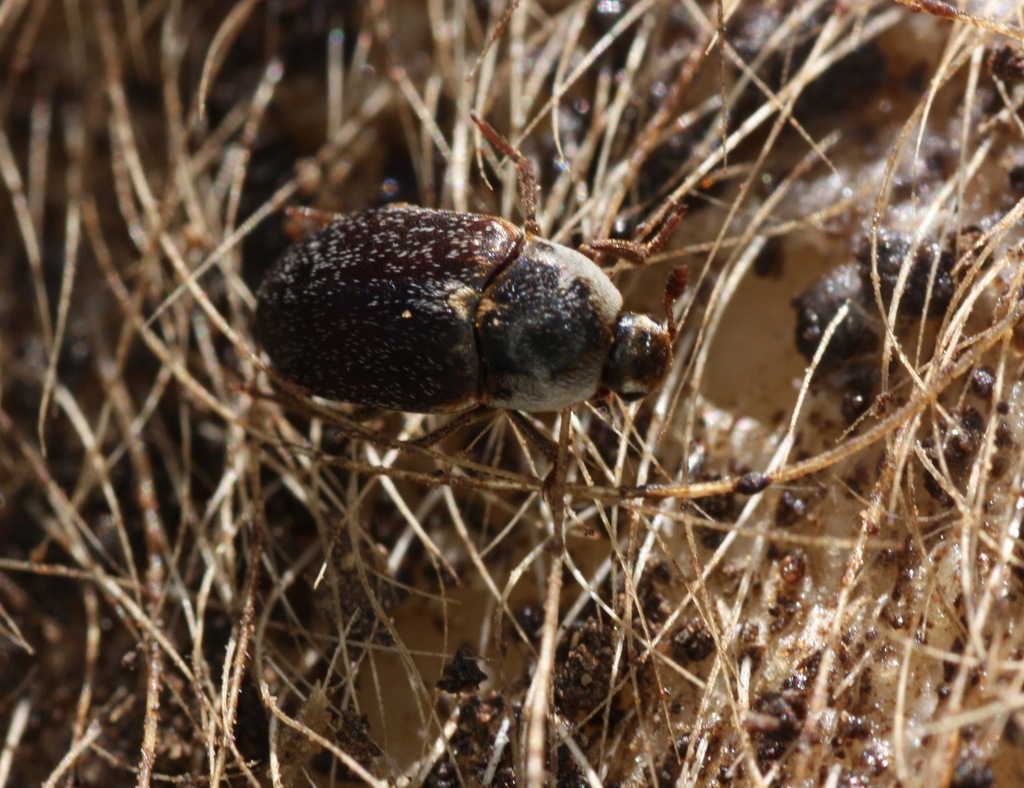
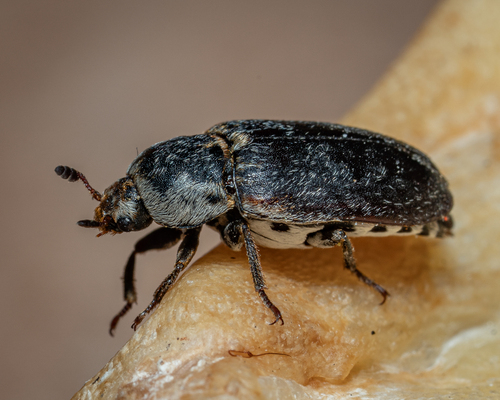
Adults are oval, dark brown to black and measure about 6 to 9.5 mm, while mature larvae reach 13 to 15 mm. Females start laying eggs in spring and can produce from 40 up to several hundred eggs over two months; development speeds up at higher temperatures.
Source: Wikipedia
How to recognize it
The sides of the pronotum are covered with yellow-white hairs.
Source: Wikipedia
Size
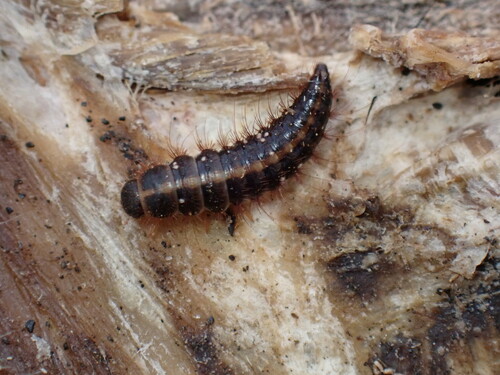
Adult beetles are 6 to 9.5 mm long, oval and dark brown to black. Fully grown larvae are 13 to 15 mm long.
Source: Wikipedia
Is it a pest in the house?
They are pests of stored animal foods and can damage wood, cork and plaster in homes.
Source: Wikipedia
Where it lives
They feed on dried animal products such as meat, fish, cheese, fur and leather. They also bore into wood, cork and plaster while looking for places to pupate.
Source: Wikipedia
What it eats
Adults and larvae eat a variety of dried animal foods such as meat, fish, cheese, fur and leather. Eggs are laid on animal-origin materials that will serve as food for the hatchlings.
Source: Wikipedia
Life cycle
Females begin laying eggs in spring and may deposit from 40 to over 400 eggs in about two months. Development is faster and involves fewer stages at 26 °C compared with 23 °C.
Source: Wikipedia
When you see it
Egg-laying starts in the spring.
Source: Wikipedia
Where it comes from
They occur across the Palearctic region, including Europe, North Africa, the Near East, parts of Africa, the Nearctic, and East Asia.
Source: Wikipedia
Lookalikes
Their larvae resemble those of Dermestes maculatus, but the dorsal band is broken on the prothorax, unlike D. maculatus.
Source: Wikipedia
Where it is found in the US
Recorded in 25 of 51 states and DC. Most records: California, Michigan, New York, Illinois, Oregon, Colorado, Arizona, Idaho.
Darker = more records. Counts are museum and citizen-science records, not population size.
Source: GBIF
Months it is reported in the US
Source: GBIF
More photos
Questions people ask
What does the adult Fringed Larder Beetle look like?
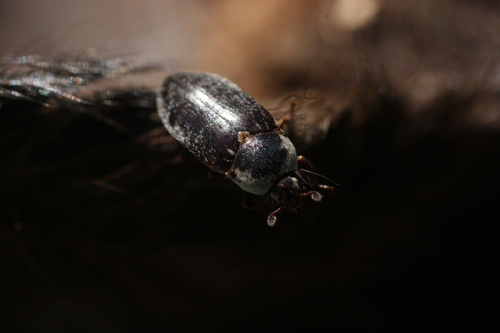
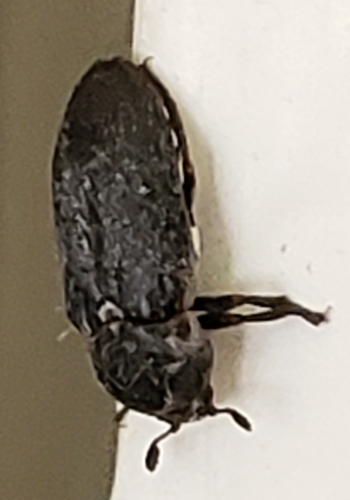
Adults are oval, dark brown to black, 6 to 9.5 mm long, and have yellow-white hairs on the sides of the pronotum.
Source: Wikipedia
What do these beetles eat?
They feed on dried animal products such as meat, fish, cheese, fur and leather, and lay eggs on those same materials.
Source: Wikipedia
When do they lay eggs?
Females start laying eggs in spring and can produce dozens to several hundred eggs over a two-month period.
Source: Wikipedia
How can I tell their larvae apart from similar beetle larvae?
The larval dorsal band is broken on the prothorax, which does not occur in Dermestes maculatus larvae.
Source: Wikipedia
Same family (Dermestidae)
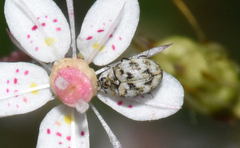 Varied Carpet BeetleAnthrenus verbasciCan damage your home
 Larder BeetleDermestes lardariusCan damage your home
 Buffalo carpet beetleAnthrenus scrophulariaeCan damage your home
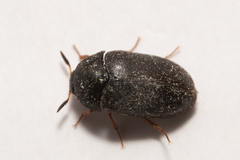 Black Carpet BeetleAttagenus unicolorCan damage your home
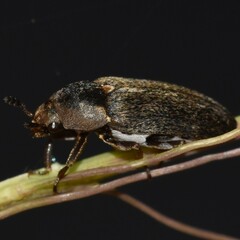 Hide BeetleDermestes maculatusCan damage your home
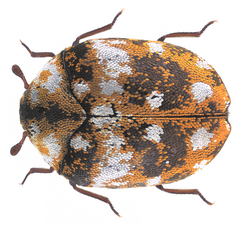 Furniture Carpet BeetleAnthrenus flavipesCan damage your home
Sources
- Wikipedia: https://en.wikipedia.org/wiki/Dermestes_frischii
Look it up elsewhere: GBIF · iNaturalist · BugGuide · Wikipedia
Text written 2026-10-25 from the sources above and checked sentence by sentence against them. Data fetched 2026-10-25.