 Bug FAQ
Black Carpet Beetle
Attagenus unicolor · Order: Coleoptera · Family: Dermestidae
Source: Wikipedia
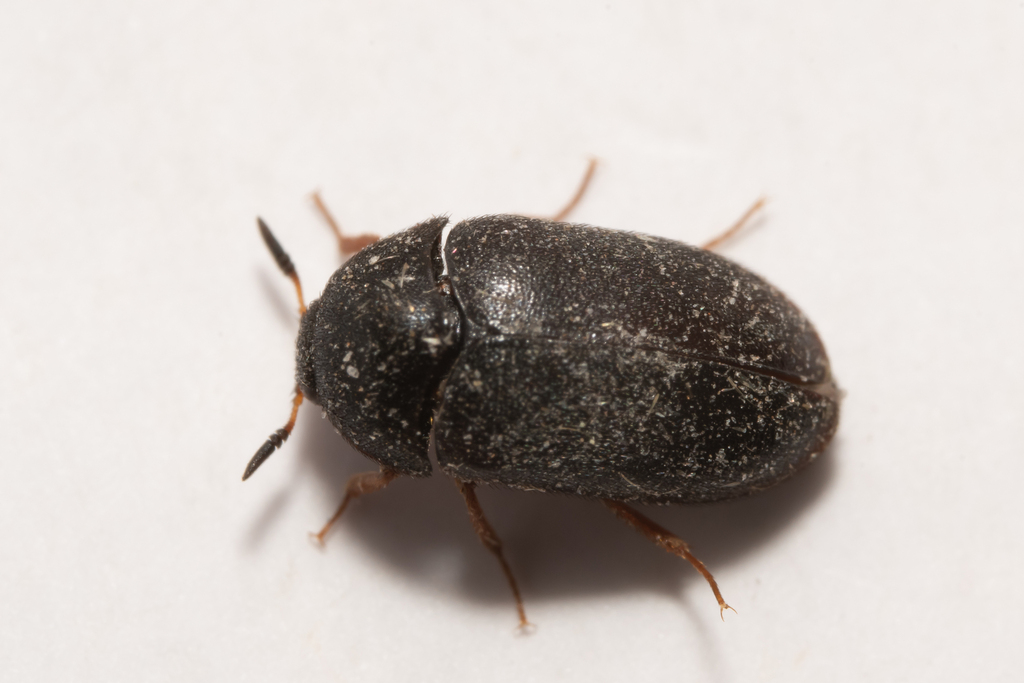
Adult black carpet beetles are tiny, 3 to 5 mm long and become completely black in color. The larvae feed on natural fibers and can ruin carpets, upholstery and clothing, making them a serious household pest.
Source: Wikipedia
How to recognize it
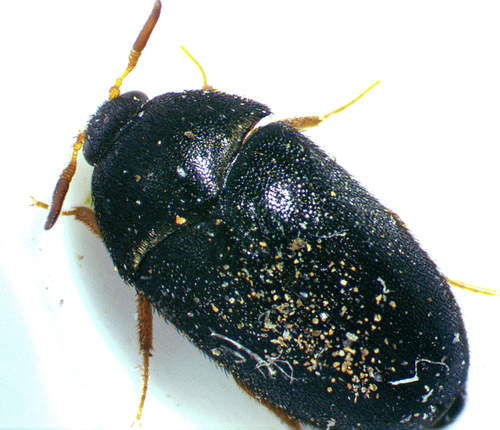
Adults turn fully black, which is why they are called black carpet beetles.
Source: Wikipedia
Size
Adults measure about 3 to 5 mm (0.12 to 0.20 in) in length.
Source: Wikipedia
Is it a pest in the house?
Both adults and larvae can be serious pests inside homes. Larval feeding damages carpets, furniture and clothing.
Source: Wikipedia
Where it lives
Females lay eggs in dark, undisturbed spots where larvae can later feed on carpet or clothing.
Source: Wikipedia
What it eats
Larvae eat natural fibers such as wool, silk, fur, and feathers, damaging household textiles. Adults rarely feed, but may consume flower pollen outdoors; they do not eat indoors.
Source: Wikipedia
Life cycle
They undergo complete metamorphosis: egg, larva, pupa, then adult.
Source: Wikipedia
Where it is found in the US
Recorded in 31 of 51 states and DC. Most records: Kentucky, Michigan, Illinois, California, New York, Pennsylvania, Vermont, Massachusetts.
Darker = more records. Counts are museum and citizen-science records, not population size.
Source: GBIF
Months it is reported in the US
Source: GBIF
More photos

Questions people ask
How can I tell if I have a black carpet beetle problem?
Look for tiny black adult beetles and damage to natural-fiber items such as carpet, upholstery or clothing.
Source: Wikipedia
Same family (Dermestidae)
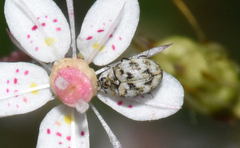 Varied Carpet BeetleAnthrenus verbasciCan damage your home
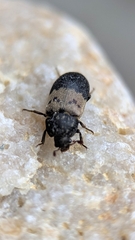 Larder BeetleDermestes lardariusCan damage your home
 Buffalo carpet beetleAnthrenus scrophulariaeCan damage your home
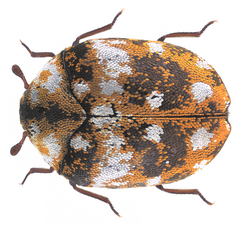 Furniture Carpet BeetleAnthrenus flavipesCan damage your home
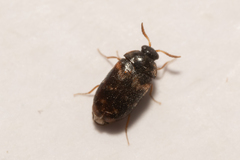 Warehouse BeetleTrogoderma variabileCan damage your home
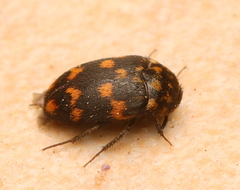 Gold Spot-row-band-dot Carpet BeetleAttagenus pustulatus
Sources
- Wikipedia: https://en.wikipedia.org/wiki/Black_carpet_beetle
Look it up elsewhere: GBIF · iNaturalist · BugGuide · ITIS · Wikipedia
Text written 2026-10-22 from the sources above and checked sentence by sentence against them. Data fetched 2026-10-22.