 Bug FAQ
Fox Moth
Macrothylacia rubi · Order: Lepidoptera · Family: Lasiocampidae
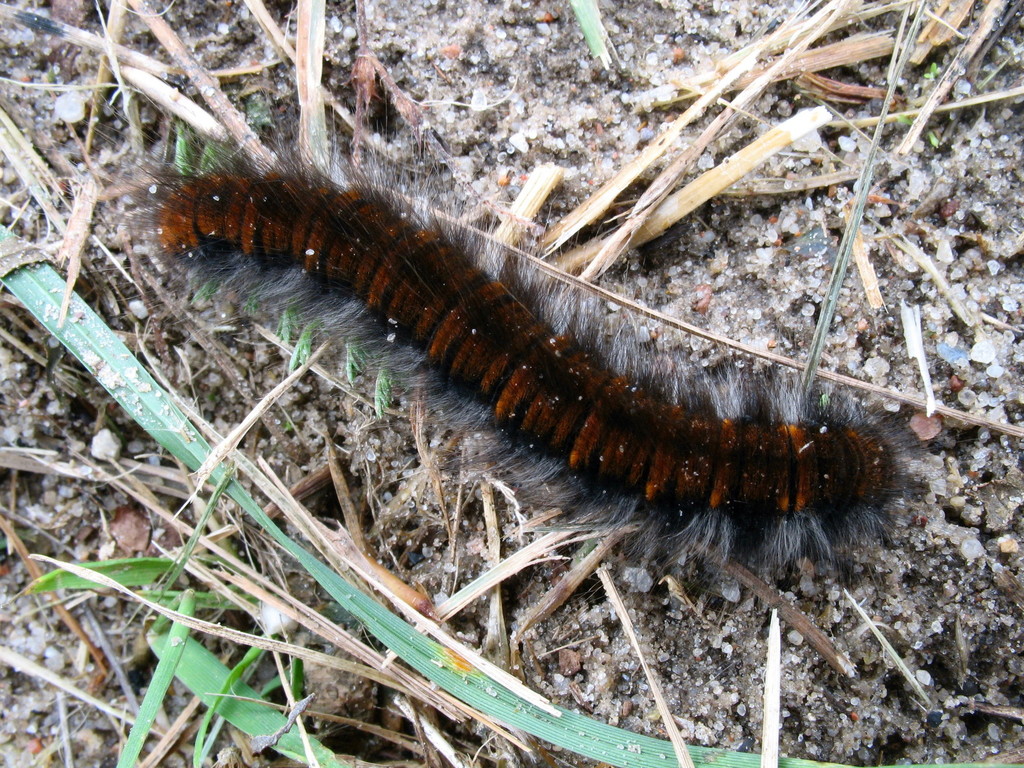
Male Fox Moths have a wingspan of about 40 to 65 mm, while the caterpillars can grow up to 80 mm long. Adults fly from May to July, with males active in the afternoon and night and females only at night.
Source: Wikipedia
How to recognize it
Males have reddish-brown wings and females are paler grey, both with two narrow light-yellow bands across the forewings.
Source: Wikipedia
Size
Male wingspan ranges from 40 to 65 mm. Caterpillars can reach about 80 mm in length.
Source: Wikipedia
Where it lives
They live in open woodlands, moors and prairies. Caterpillars spend the winter hibernating in leaf litter.
Source: Wikipedia
What it eats
Caterpillars feed on a variety of plants including heather, bramble, grasses, birch, willow, aspen, vetch, several clovers, bilberry, strawberry, cinquefoil and wood geranium.
Source: Wikipedia
Life cycle
The species has one generation per year (univoltine). Caterpillars hibernate from September to March in leaf litter.
Source: Wikipedia
When you see it
Adults are on the wing from May through July. Males fly in the afternoon and at night, while females fly only at night.
Source: Wikipedia
Where it comes from
Their range extends from western Europe across central Asia to Siberia.
Source: Wikipedia
Same family (Lasiocampidae)
 Eastern Tent Caterpillar MothMalacosoma americanaDamages trees, gardens or crops
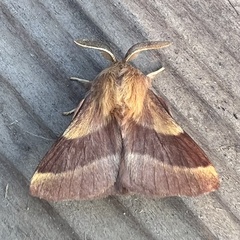 Forest Tent Caterpillar MothMalacosoma disstriaDamages trees, gardens or crops
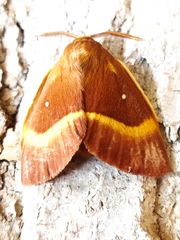 Oak EggarLasiocampa quercus
 Drinker MothEuthrix potatoria
 Western Tent Caterpillar MothMalacosoma californicaDamages trees, gardens or crops
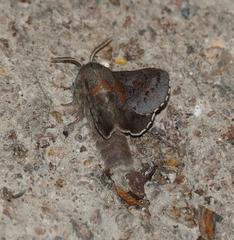 American Lappet MothPhyllodesma americanaDamages trees, gardens or crops
Sources
- Wikipedia: https://en.wikipedia.org/wiki/Macrothylacia_rubi
Look it up elsewhere: GBIF · iNaturalist · BugGuide · Wikipedia
Text written 2026-10-22 from the sources above and checked sentence by sentence against them. Data fetched 2026-10-22.