 Bug FAQ
Four-spot Orbweaver
Araneus quadratus · Order: Araneae · Family: Araneidae
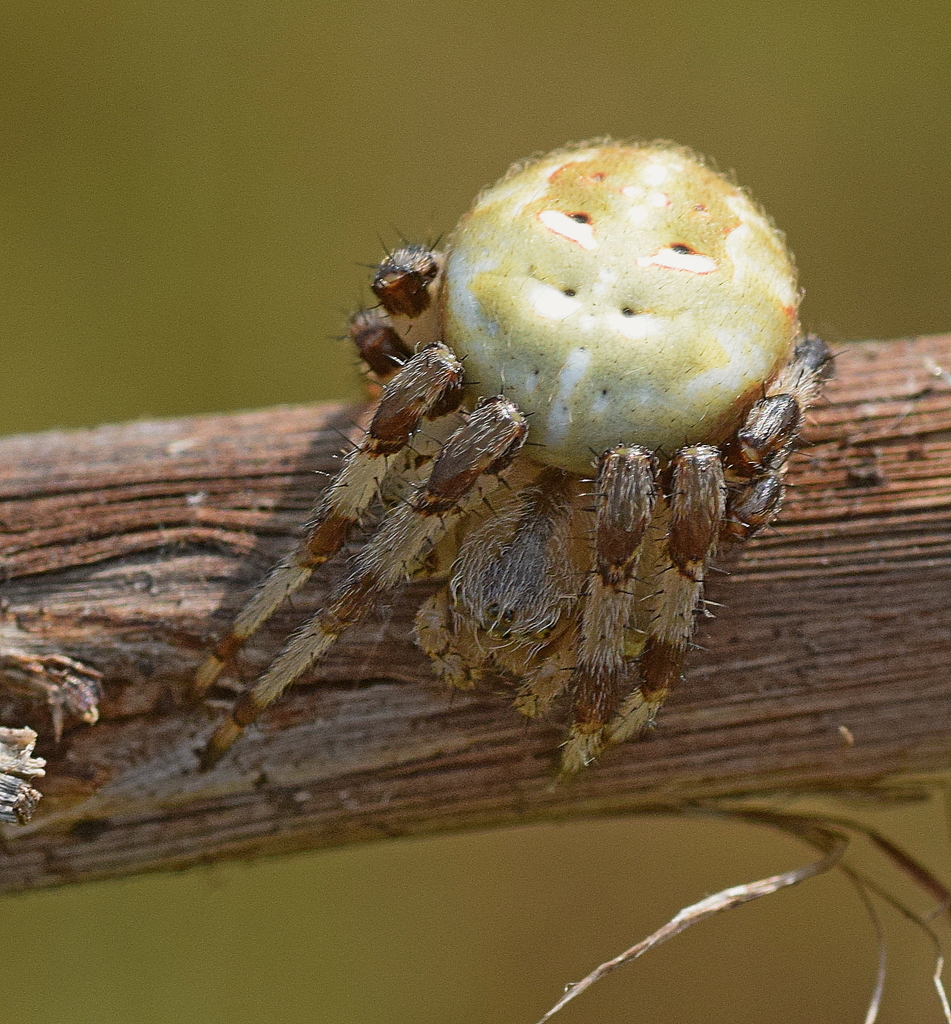
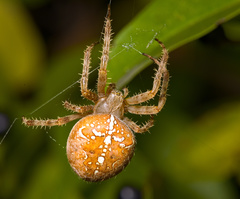
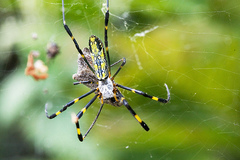
Females grow up to about 17 mm long, while males are roughly half that size. They can be brown, orange or green but always show four white spots on the abdomen, and darker forms are easier to spot because of the contrast.
Source: Wikipedia
How to recognize it
They always have four white spots on the abdomen; body colour varies from brown to bright orange or green, and darker spiders show the spots more clearly.
Source: Wikipedia
Where it lives
They are found in gardens, wooded areas, or any place with vegetation suitable for anchoring an orb web. Their webs are built low to the ground to capture jumping insects such as small grasshoppers.
Source: Wikipedia
What it eats
They catch and eat jumping insects, especially small grasshoppers, using their low-lying orb webs.
Source: Wikipedia
Life cycle
Adult females can actively change their colour to match their surroundings, a process that takes about three days.
Source: Wikipedia
Where it comes from
The species is common across Europe and Central Asia, extending east to the Kamchatka Peninsula and Japan.
Source: Wikipedia
Where it is found in the US
Recorded in 1 of 51 states and DC. Most records: Texas.
Darker = more records. Counts are museum and citizen-science records, not population size.
Source: GBIF
More photos
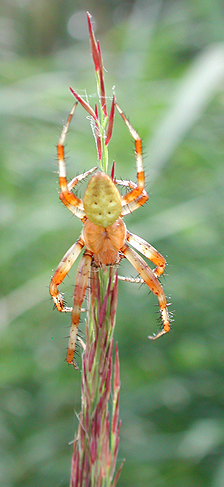
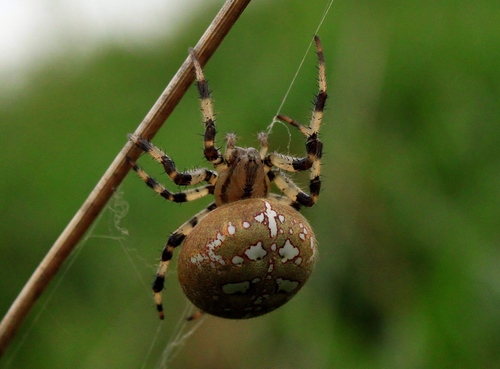
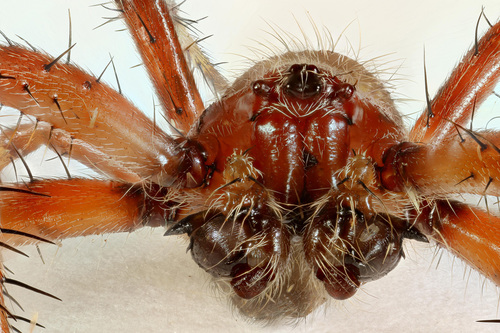
Same family (Araneidae)

Sources
- Wikipedia: https://en.wikipedia.org/wiki/Araneus_quadratus
Look it up elsewhere: GBIF · iNaturalist · BugGuide · ITIS · Wikipedia
Text written 2026-10-22 from the sources above and checked sentence by sentence against them. Data fetched 2026-10-22.