 Bug FAQ
Florida Predatory Stink Bug
Euthyrhynchus floridanus · Order: Hemiptera · Family: Pentatomidae

Adult males are about 12 mm long and females can reach 17 mm. They are usually bluish-black or purplish-brown with red spots on the scutellum and have a spine on the humerus but lack a front-leg femur spine. They live on many plants, from ornamentals to citrus and grasses, and the female lays 20-90 eggs; nymphs pass through five instars.
Source: Wikipedia
How to recognize it
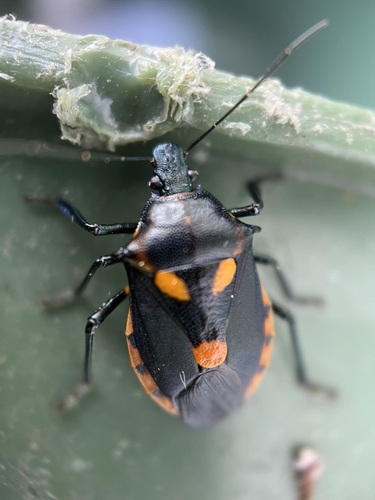
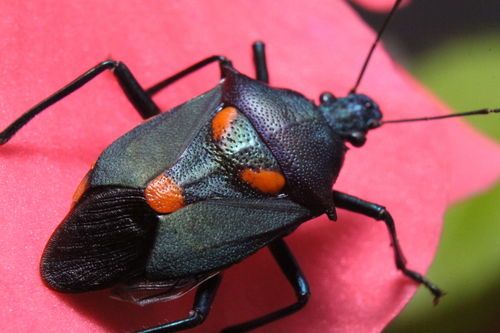
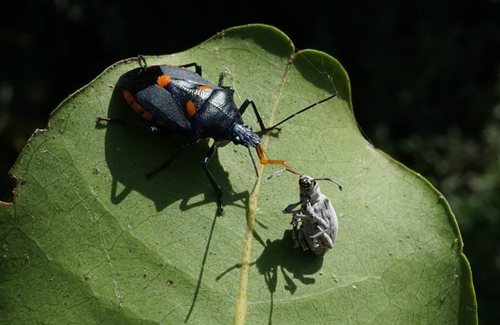
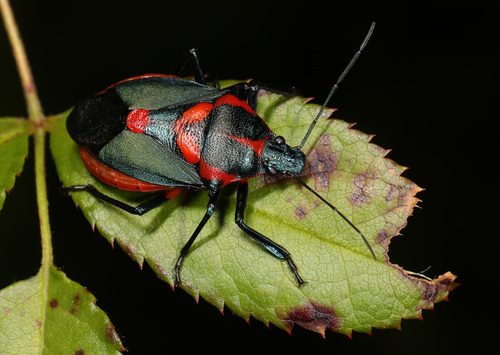
The bug’s ground colour is typically bluish-black or purplish-brown with red spots on the sides and rear of the scutellum. A distinctive spine is present on the humerus, while the front-leg femur lacks the underside spine seen in similar Florida species.
Source: Wikipedia
Size
Males are about 12 mm (0.5 in) long; females can grow to about 17 mm (0.7 in).
Source: Wikipedia
What it eats
In the lab, nymphs have eaten greater wax moth larvae, Mexican bean beetle stages, tobacco budworm larvae and black cutworm larvae.
Source: Wikipedia
Life cycle
Females lay batches of 20-90 eggs. Nymphs pass through five instars, showing bluish-black heads and thoraxes with red abdomens.
Source: Wikipedia
When you see it
Its development period is longer than that of close relatives in the subfamily Asopinae.
Source: Wikipedia
Lookalikes
It can be distinguished from similar Florida species by the absence of a spine on the underside of the front-leg femur.
Source: Wikipedia
Where it is found in the US
Recorded in 21 of 51 states and DC. Most records: North Carolina, Virginia, Maryland, Tennessee, Georgia, South Carolina, Alabama, Florida.
Darker = more records. Counts are museum and citizen-science records, not population size.
Source: GBIF
Months it is reported in the US
Source: GBIF
More photos
Questions people ask
Where are they found?
They occur on many plant types, including ornamentals, citrus, weeds, grasses, trees and bushes.
Source: Wikipedia
How can I tell this bug apart from similar ones?
Look for a spine on the humerus and the lack of a spine on the underside of the front-leg femur; also note the bluish-black or purplish-brown colour with red scutellum spots.
Source: Wikipedia
Same family (Pentatomidae)
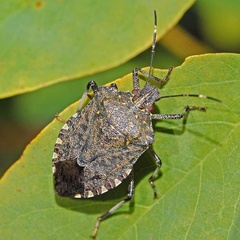 Brown Marmorated Stink BugHalyomorpha halysDamages trees, gardens or crops
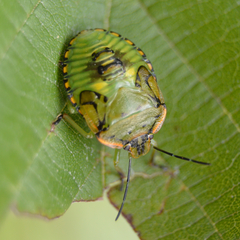 Green Stink BugChinavia hilarisDamages trees, gardens or crops
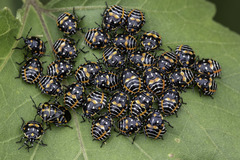 Harlequin BugMurgantia histrionicaDamages trees, gardens or crops
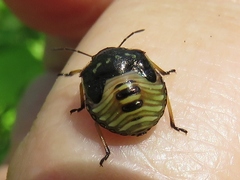 Brown Stink BugEuschistus servusDamages trees, gardens or crops
 Green Shield BugPalomena prasina
 European Striped Shield BugGraphosoma italicum
Sources
- Wikipedia: https://en.wikipedia.org/wiki/Euthyrhynchus_floridanus
Look it up elsewhere: GBIF · iNaturalist · BugGuide · ITIS · Wikipedia
Text written 2026-10-22 from the sources above and checked sentence by sentence against them. Data fetched 2026-10-22.