 Bug FAQ
Figwort sawfly
Tenthredo scrophulariae · Order: Hymenoptera · Family: Tenthredinidae
Source: Wikipedia


Adult figwort sawflies are about 11 to 15 mm long and look like wasps without a thin waist, with black heads, yellow-black thorax and orange-red wing edges. Larvae are large, up to 30 mm, have 22 legs and eat the leaves of figwort, Buddleja and black mullein in late summer. Adults fly from May to August, while larvae feed in August-September and hibernate in October.
Source: Wikipedia
How to recognize it
Looks wasp-like but lacks a narrow waist; head is short and black with rectangular corners; thorax mostly black with yellow pronotum and scutellum; abdomen black with yellow bands; forewing edge bright orange-red, rest of wing pale yellowish-gray; front legs yellow with black femur tops; middle and rear legs orange, rear femurs black.
Source: Wikipedia
Size
Adults measure about 11 to 15 mm in length. Larvae grow to roughly 30 mm and have 22 legs.
Source: Wikipedia
Where it lives
Found in European meadows where figwort grows.
Source: Wikipedia
What it eats
Larvae feed on figwort leaves and also on older leaves of Buddleja and black mullein. Adults eat small insects and visit umbellifers for nectar and pollen.
Source: Wikipedia
Life cycle
Larvae feed in August-September, then hibernate from October.
Source: Wikipedia
When you see it
Adults are on the wing from May through August.
Source: Wikipedia
Where it comes from
Native to Europe, Turkey and the Transcaucasian region.
Source: Wikipedia
Lookalikes
Unlike most Tenthredo species, this one is orange-colored rather than black, and its antenna flagellum is short and not narrowed at the tip.
Source: Wikipedia
More photos


Questions people ask
What do the larvae eat?
They feed on figwort leaves and also on older leaves of Buddleja and black mullein.
Source: Wikipedia
How can I recognise a figwort sawfly?
It looks like a wasp without a thin waist, has a short black head, a mostly black thorax with yellow pronotum and scutellum, a black abdomen with yellow bands, and bright orange-red leading wing edges.
Source: Wikipedia
Same family (Tenthredinidae)
 Willow Apple Gall SawflyEuura californica
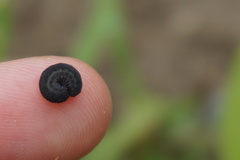 Turnip SawflyAthalia rosaeNuisance, not dangerous
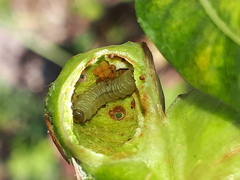 Willow Redgall SawflyEuura proxima
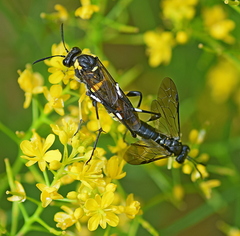 Yellow-spotted MacrophyaMacrophya montanaDamages trees, gardens or crops
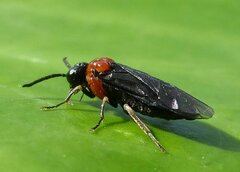 Saddleback Grass-cutterEutomostethus ephippiumDamages trees, gardens or crops
 Cherry Slug SawflyCaliroa cerasi
Sources
- Wikipedia: https://en.wikipedia.org/wiki/Tenthredo_scrophulariae
Look it up elsewhere: GBIF · iNaturalist · BugGuide · Wikipedia
Text written 2026-10-23 from the sources above and checked sentence by sentence against them. Data fetched 2026-10-22.