 Bug FAQ
Fig Tree Borer
Neoptychodes trilineatus · Order: Coleoptera · Family: Cerambycidae
Source: Wikipedia
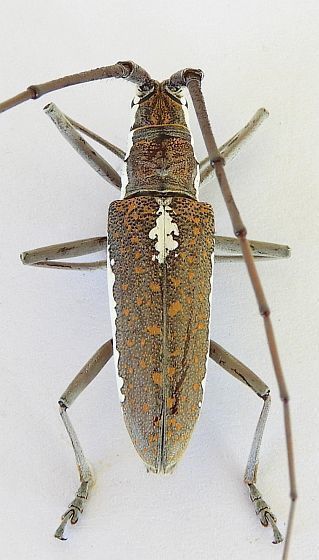
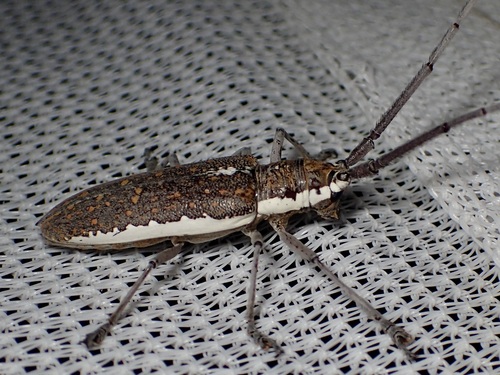
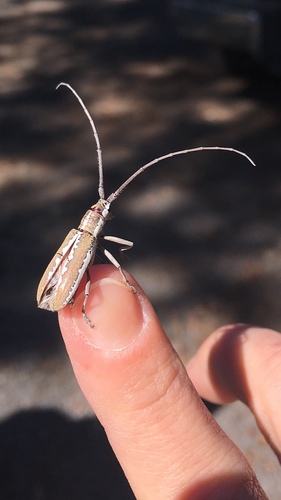
Adults are 19 to 35 mm long, with males generally larger than females. Their backs are usually dark brown or gray with orange-brown spots and three light longitudinal stripes. They occur from Central America through the Caribbean into the United States and northern South America.
Source: Wikipedia
Size
Males measure about 21 to 35 mm, while females are slightly smaller at 19 to 31 mm.
Source: Wikipedia
Where it lives
It feeds on fig, mulberry, willow and alder trees.
Source: Wikipedia
What it eats
Its main host plants are fig, mulberry, willow and alder species.
Source: Wikipedia
Where it is found in the US
Recorded in 7 of 51 states and DC. Most records: Louisiana, Arizona, Texas, Alabama, Mississippi, Florida, South Carolina.
Darker = more records. Counts are museum and citizen-science records, not population size.
Source: GBIF
Months it is reported in the US
Source: GBIF
More photos
Questions people ask
What trees does the Fig Tree Borer damage?
It attacks fig, mulberry, willow and alder trees, feeding on their wood and foliage.
Source: Wikipedia
How can I recognize an adult Fig Tree Borer?
Look for a beetle 19 to 35 mm long with a dark brown or gray body, orange-brown spots on the wing covers, and three light longitudinal stripes.
Source: Wikipedia
Same family (Cerambycidae)
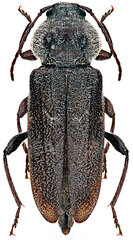 House LonghornHylotrupes bajulusCan damage your home
 Asian Longhorned BeetleAnoplophora glabripennisDamages trees, gardens or crops
 Red Milkweed BeetleTetraopes tetrophthalmus
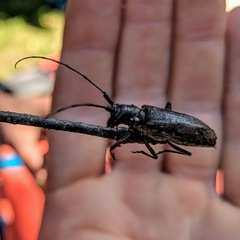 White-spotted SawyerMonochamus scutellatusCan damage your home
 Red Pine Longhorn BeetleStictoleptura rubra
 Spotted Longhorn BeetleRutpela maculata
Sources
- Wikipedia: https://en.wikipedia.org/wiki/Neoptychodes_trilineatus
Look it up elsewhere: GBIF · iNaturalist · BugGuide · ITIS · Wikipedia
Text written 2026-10-28 from the sources above and checked sentence by sentence against them. Data fetched 2026-10-28.