 Bug FAQ
Fairy-ring Longhorn Beetle
Pseudovadonia livida · Order: Coleoptera · Family: Cerambycidae
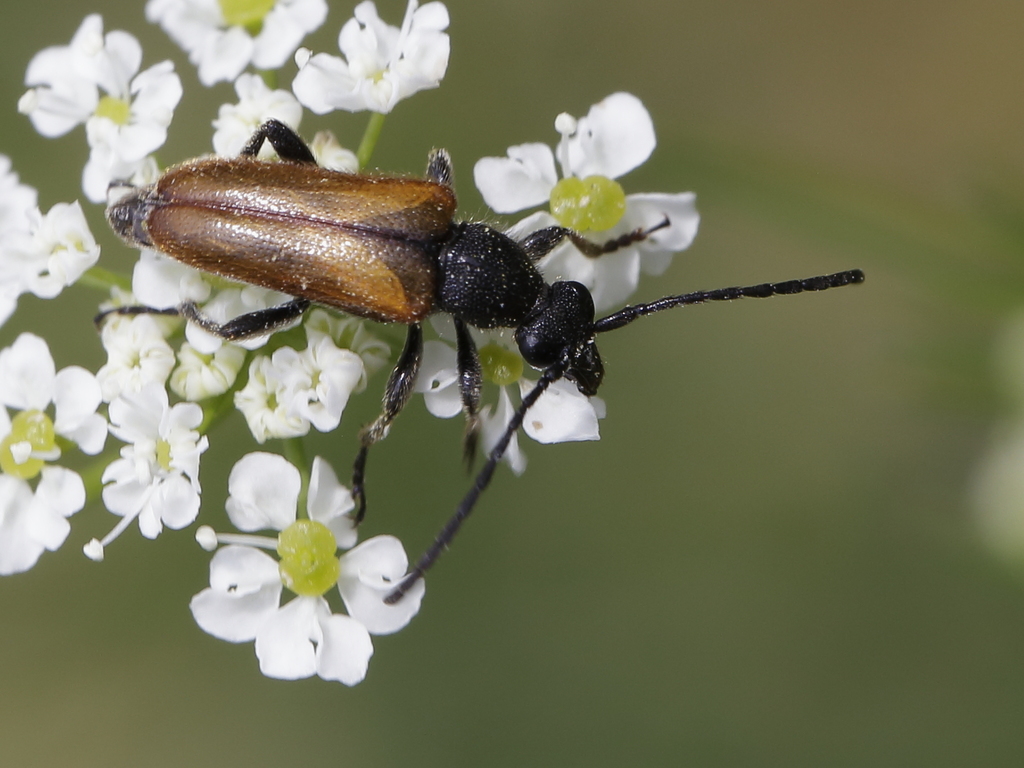
Adults are small, 5 to 9 mm long, with a broad head, shiny black pronotum and reddish-brown elytra covered in fine golden hairs. They live in pine and mixed forests across most of Europe and parts of Asia, visiting flowers for pollen and nectar. Larvae grow in fungus-infested humus, not in dead wood, and the species has a two-year life cycle with adults seen from May to September.
Source: Wikipedia
How to recognize it
The beetle has a robust body, broad head with large eyes, dense punctures, and erect pubescence. Its pronotum is square, shiny black with shallow punctures, and the scutellum is also black and glossy. Elytra are reddish-brown with a darker seam, shoulders wider than the pronotum base, and covered in fine semi-erect golden hair.
Source: Wikipedia
Size
Adults measure between 5 and 9 mm in length.
Source: Wikipedia
Where it lives
It mainly lives in pine forests but also occurs on oak and chestnut trees.
Source: Wikipedia
What it eats
Adults feed on pollen and nectar, especially from Apiaceae flowers. Larvae develop in humus infected by the fungus Marasmius oreades, feeding on the fungal mycelium.
Source: Wikipedia
Life cycle
The beetle completes its life cycle in two years, with adults appearing from May through September.
Source: Wikipedia
When you see it
Adults can be seen from May to September.
Source: Wikipedia
Where it comes from
The species is widespread throughout most of Europe, the eastern Palearctic, and the Near East.
Source: Wikipedia
More photos


Questions people ask
Same family (Cerambycidae)
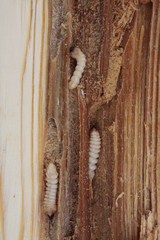 House LonghornHylotrupes bajulusCan damage your home
 Asian Longhorned BeetleAnoplophora glabripennisDamages trees, gardens or crops
 Red Milkweed BeetleTetraopes tetrophthalmus
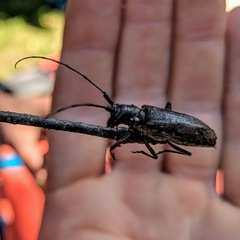 White-spotted SawyerMonochamus scutellatusCan damage your home
 Red Pine Longhorn BeetleStictoleptura rubra
 Spotted Longhorn BeetleRutpela maculataDamages trees, gardens or crops
Sources
- Wikipedia: https://en.wikipedia.org/wiki/Pseudovadonia_livida
Look it up elsewhere: GBIF · iNaturalist · BugGuide · Wikipedia
Text written 2026-10-22 from the sources above and checked sentence by sentence against them. Data fetched 2026-10-22.