 Bug FAQ
Eyed Ladybird Beetle
Anatis ocellata · Order: Coleoptera · Family: Coccinellidae
Also called: Eyed Labybug, Eyed Ladybird

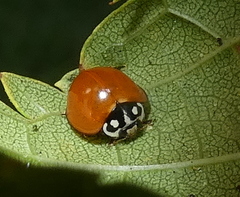
The Eyed Ladybird Beetle shows red or brown wing covers with black spots surrounded by yellow halos; in some cases the spots merge into lines. It lives in temperate coniferous forests, especially on pines and other conifers, as well as birch and poplar trees. Adults feed on aphids found on coniferous trees and overwinter as adults.
Source: Wikipedia
How to recognize it
Red or brown wing covers have black spots with yellowish halos; some individuals have spots that form longitudinal lines.
Source: Wikipedia
Where it lives
Found mainly in temperate coniferous forests such as Central European mixed forests, Sarmatic mixed forests, and Scandinavian montane birch forest. Commonly seen on pines, spruces (including Picea abies), birches, and aspen.
Source: Wikipedia
Life cycle
The adult beetles overwinter.
Source: Wikipedia
When you see it
Adults are present throughout the year because they overwinter as adults.
Source: Wikipedia
Where it comes from
Its range includes continental Europe, trans-continental Russia, Central Asia, Mongolia, northern China, Western Canada, the Korean Peninsula, and Turkey.
Source: Wikipedia
Where it is found in the US
Recorded in 4 of 51 states and DC. Most records: Michigan, Indiana, Pennsylvania, Illinois.
Darker = more records. Counts are museum and citizen-science records, not population size.
Source: GBIF
Questions people ask
Are they a problem for gardens or trees?
They actually help by eating aphids that can damage trees and shrubs.
Source: Wikipedia
Same family (Coccinellidae)

Sources
- Wikipedia: https://en.wikipedia.org/wiki/Anatis_ocellata
Look it up elsewhere: GBIF · iNaturalist · BugGuide · Wikipedia
Text written 2026-10-22 from the sources above and checked sentence by sentence against them. Data fetched 2026-10-22.