 Bug FAQ
European tube wasp
Ancistrocerus gazella · Order: Hymenoptera · Family: Vespidae
Also called: European Potter Wasp
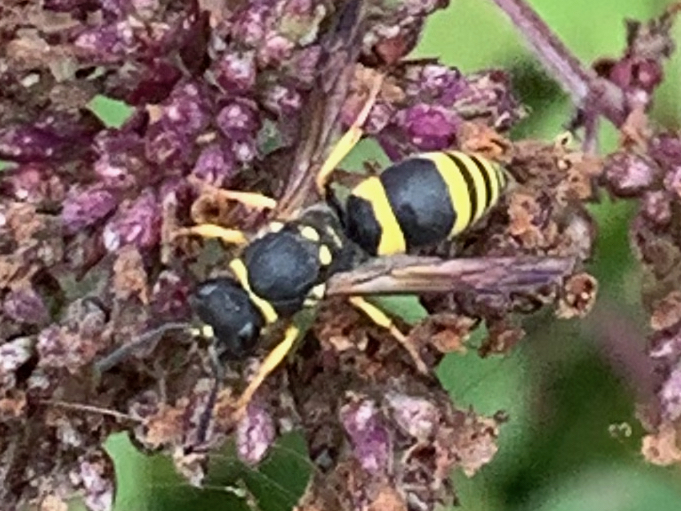
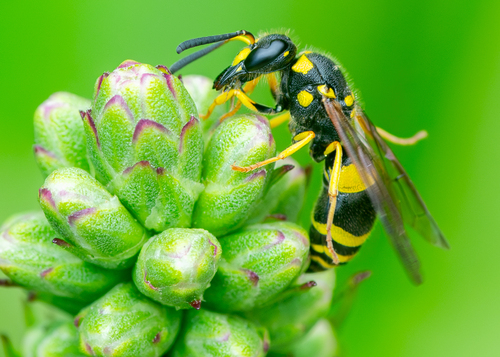
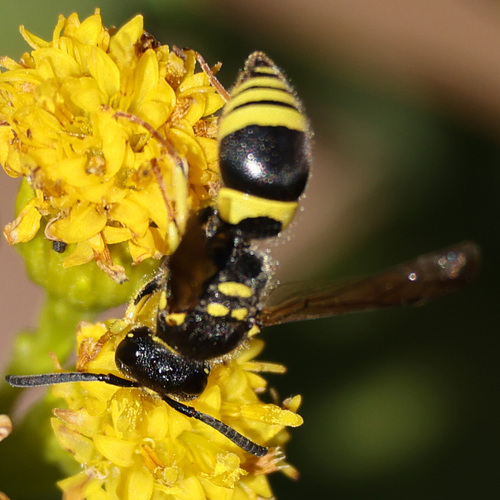
Adult females collect up to 20 caterpillars for each single-cell nest and stock it with paralyzed prey before sealing it with clay. They live in sandy or clay soils such as river banks, coastal areas, parks, open woods and urban spots, often nesting in cracks or holes and can be seen on windows or on flowers. Adults feed on nectar and aphid honeydew, while the larvae eat the stored caterpillars and develop in about two weeks before emerging as adults.
Source: Wikipedia
How to recognize it
A female adult gathers as many as twenty caterpillars for each single-cell nest.
Source: Wikipedia
Does it bite or sting?
Males lack a sting, and a female’s sting is not painful.
Source: Wikipedia
Where it lives
They occupy habitats with suitable sandy or clay soil, including river banks, coastal zones, parkland, open woodland and urban areas. You may find them on windows, visiting flowers for nectar, or searching small cracks and holes to build nests.
Source: Wikipedia
What it eats
Adult wasps drink nectar and aphid honeydew. Females stock each nest cell with several paralyzed caterpillars for the developing larva.
Source: Wikipedia
Life cycle
Eggs hatch in a few days and the larvae consume the stored caterpillars in ten to twelve days.
Source: Wikipedia
Where it comes from
They also occur in Morocco.
Source: Wikipedia
Where it is found in the US
Recorded in 32 of 51 states and DC. Most records: Massachusetts, New York, Ohio, Illinois, Pennsylvania, Michigan, Virginia, New Jersey.
Darker = more records. Counts are museum and citizen-science records, not population size.
Source: GBIF
Status: introduced in Canada. Source: iNaturalist
Months it is reported in the US
Source: GBIF
More photos
Questions people ask
Do they sting people?
Females can sting but the sting is not painful, and males cannot sting at all.
Source: Wikipedia
What do they eat?
Adults sip nectar and aphid honeydew, while females collect caterpillars to feed their larvae.
Source: Wikipedia
Where might I find them around my home?
They like sandy or clay soils and can be seen on windows, on flowers, or nesting in small cracks and holes in walls or garden structures.
Source: Wikipedia
Same family (Vespidae)


Sources
- Wikipedia: https://en.wikipedia.org/wiki/Ancistrocerus_gazella
Look it up elsewhere: GBIF · iNaturalist · BugGuide · Wikipedia
Text written 2026-10-22 from the sources above and checked sentence by sentence against them. Data fetched 2026-10-22.