 Bug FAQ
Eleven-spotted Ladybird Beetle
Coccinella undecimpunctata · Order: Coleoptera · Family: Coccinellidae
Also called: Ladybird beetle, Eleven-spotted Lady Beetle
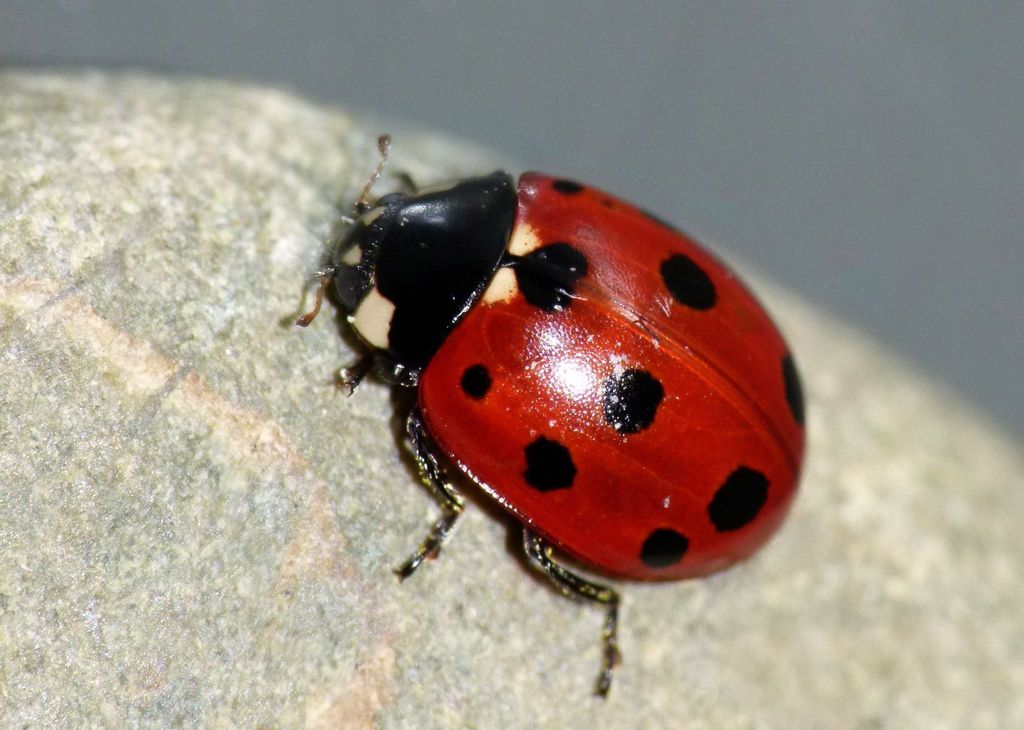
The eleven-spotted ladybird is a small red or orange beetle with eleven black spots on its wing covers, looking like six spots per side plus a central spot. It lives in grassy open areas such as fields, meadows, steppe, riverbanks and waste places, often where grasses and certain shrubs grow. Native to the Palearctic region, it ranges from central Asia across Europe, North Africa and into parts of Asia including China and India.
Source: Wikipedia
How to recognize it
Eleven black spots appear on the red/orange elytra; the middle spot behind the pronotum counts as one, making it look like six per side.
Source: Wikipedia
Size
Adults measure about 4 to 5 mm in length.
Source: Wikipedia
How to get rid of it
Can be released as a biological control agent, preferably when pest numbers are low.
Source: Wikipedia
Where it lives
Found in fields, steppe, stone quarries, wastelands, dry forest edges, coastal meadows and near rivers where grasses grow. Also occurs on alluvial soils, dead grass, and in habitats with Ammophila arenaria or Salix purpurea.
Source: Wikipedia
What it eats
Feeds on aphids that live on grasses. Effective at controlling cotton mealybugs, with females eating more than males over their lives.
Source: Wikipedia
Life cycle
Reproduces sexually and may eat the eggs of other individuals or pairs, which improves its own egg viability and speeds development of the remaining offspring.
Source: Wikipedia
Where it comes from
Native to central Asia and broadly distributed across the Palearctic, including Europe, North Africa, Russia, the Caucasus, Siberia, the Far East, Ukraine, Moldova, Kazakhstan, Central and Western Asia, Mongolia, China, Pakistan and northern India.
Source: Wikipedia
Where it is found in the US
Recorded in 9 of 51 states and DC. Most records: Washington, Massachusetts, Oregon, California, New York, Vermont, Pennsylvania, Indiana.
Darker = more records. Counts are museum and citizen-science records, not population size.
Source: GBIF
Status: introduced in United States; introduced in Canada. Source: iNaturalist
Months it is reported in the US
Source: GBIF
More photos



Questions people ask
How can I identify the eleven-spotted ladybird?
Look for a small (4 to 5 mm) red or orange beetle with eleven distinct black spots on its wing covers, the central spot counting as one.
Source: Wikipedia
What does this ladybird eat?
It preys on aphids that live on grasses and can also help control cotton mealybugs.
Source: Wikipedia
Can I use it for garden pest control?
Yes, release them when pest insects are present in low numbers to help keep aphid populations down.
Source: Wikipedia
Same family (Coccinellidae)

Sources
- Wikipedia: https://en.wikipedia.org/wiki/Coccinella_undecimpunctata
Look it up elsewhere: GBIF · iNaturalist · BugGuide · ITIS · Wikipedia
Text written 2026-10-22 from the sources above and checked sentence by sentence against them. Data fetched 2026-10-22.