 Bug FAQ
Dinoptera collaris
Dinoptera collaris · Order: Coleoptera · Family: Cerambycidae
Source: Wikipedia
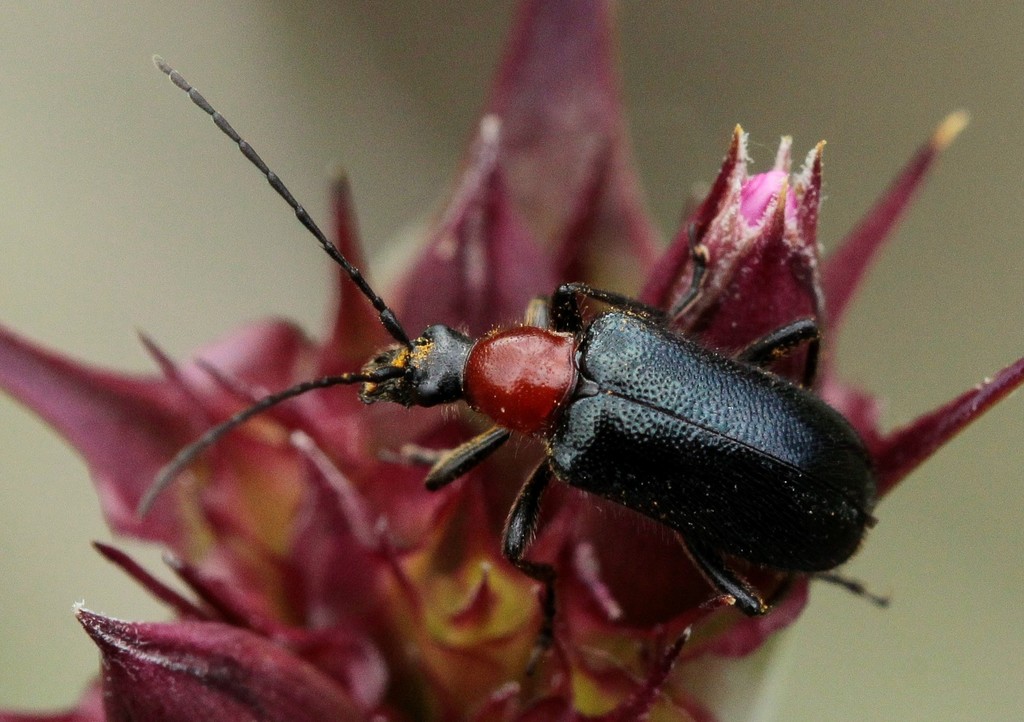
Dinoptera collaris is a small beetle about 6 to 9 mm long, with bluish-black hairy wing covers and an almost spherical orange-red pronotum. It lives in deciduous forests, especially beech woods and hedgerows across most of Europe and the Near East. The larvae bore into the bark of oak, aspen and apple trees, while adults feed on pollen of various flowering plants from April to August.
Source: Wikipedia
Size
Adults measure between 6 and 9 mm in length (0.24 to 0.35 in).
Source: Wikipedia
Where it lives
They inhabit deciduous forests, preferring beech stands and hedge rows.
Source: Wikipedia
What it eats
Larvae develop under loose bark of oak, aspen or apple trees and feed as polyphagous wood borers on many deciduous trees.
Source: Wikipedia
Life cycle
The life cycle lasts two years, with larvae overwintering and pupating the following spring.
Source: Wikipedia
When you see it
Adult beetles are active from April through August.
Source: Wikipedia
Where it comes from
The species occurs throughout most of Europe and the Near East, including countries such as France, Germany, Italy, the United Kingdom, Turkey and Iran.
Source: Wikipedia
Lookalikes
It resembles Acmaeops marginatus, Acmaeops pratensis and Acmaeops septentrionis.
Source: Wikipedia
Questions people ask
Which trees are affected by the larvae?
The larvae bore into the bark of oak, aspen and apple trees and can damage other deciduous species as well.
Source: Wikipedia
What does this beetle look like?
It is 6 to 9 mm long, with bluish-black hairy elytra, a nearly spherical orange-red pronotum, long antennae and an orange-red abdomen.
Source: Wikipedia
Same family (Cerambycidae)
 House LonghornHylotrupes bajulusCan damage your home
 Asian Longhorned BeetleAnoplophora glabripennisDamages trees, gardens or crops
 Red Milkweed BeetleTetraopes tetrophthalmus
 White-spotted SawyerMonochamus scutellatusCan damage your home
 Red Pine Longhorn BeetleStictoleptura rubra
 Spotted Longhorn BeetleRutpela maculataDamages trees, gardens or crops
Sources
- Wikipedia: https://en.wikipedia.org/wiki/Dinoptera_collaris
Look it up elsewhere: GBIF · iNaturalist · BugGuide · Wikipedia
Text written 2026-10-23 from the sources above and checked sentence by sentence against them. Data fetched 2026-10-22.