 Bug FAQ
Diamesus osculans
Diamesus osculans · Order: Coleoptera · Family: Staphylinidae

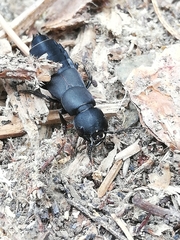
Diamesus osculans is the biggest carrion beetle in the Silphinae subfamily and is often found on dead animals. It occurs across the Indo-Malayan region, including India, Sri Lanka, Indonesia, the Philippines, Laos, China and Australia. Adults are attracted to light traps and animal remains.
Source: Wikipedia
How to recognize it
Adults can be drawn to light traps and to dead animal material.
Source: Wikipedia
Size
It is the largest species of carrion beetle in the Silphinae subfamily.
Source: Wikipedia
Where it lives
The beetle is commonly found on decaying corpses, where it has forensic importance.
Source: Wikipedia
What it eats
It feeds on carrion, regularly appearing on dead animals.
Source: Wikipedia
Life cycle
Its mitochondrial genome is 19,398 base pairs long and contains 22 tRNA genes, 2 rRNA genes and 13 protein-coding genes.
Source: Wikipedia
Where it comes from
Diamesus osculans lives in the Indo-Malayan realm, recorded from India, Sri Lanka, Indonesia, the Philippines, Laos, China and Australia.
Source: Wikipedia
More photos


Questions people ask
Where is Diamesus osculans found?
It occurs in the Indo-Malayan region, including India, Sri Lanka, Indonesia, the Philippines, Laos, China and Australia.
Source: Wikipedia
How can I attract Diamesus osculans for study?
Adults are attracted to light traps and to animal remains.
Source: Wikipedia
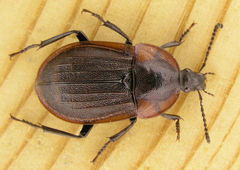
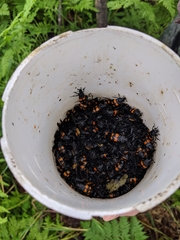
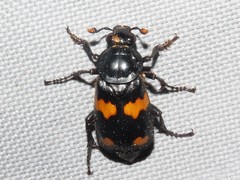
Same family (Staphylinidae)




Sources
- Wikipedia: https://en.wikipedia.org/wiki/Diamesus_osculans
Look it up elsewhere: GBIF · iNaturalist · BugGuide · Wikipedia
Text written 2026-10-23 from the sources above and checked sentence by sentence against them. Data fetched 2026-10-23.