 Bug FAQ
Cream-streaked Ladybird
Harmonia quadripunctata · Order: Coleoptera · Family: Coccinellidae
Also called: Four-spot Ladybird, Cream-streaked Ladybird Beetle, Four-spot Ladybird [Harmonia quadripunctata], Four-spotted Lady Beetle
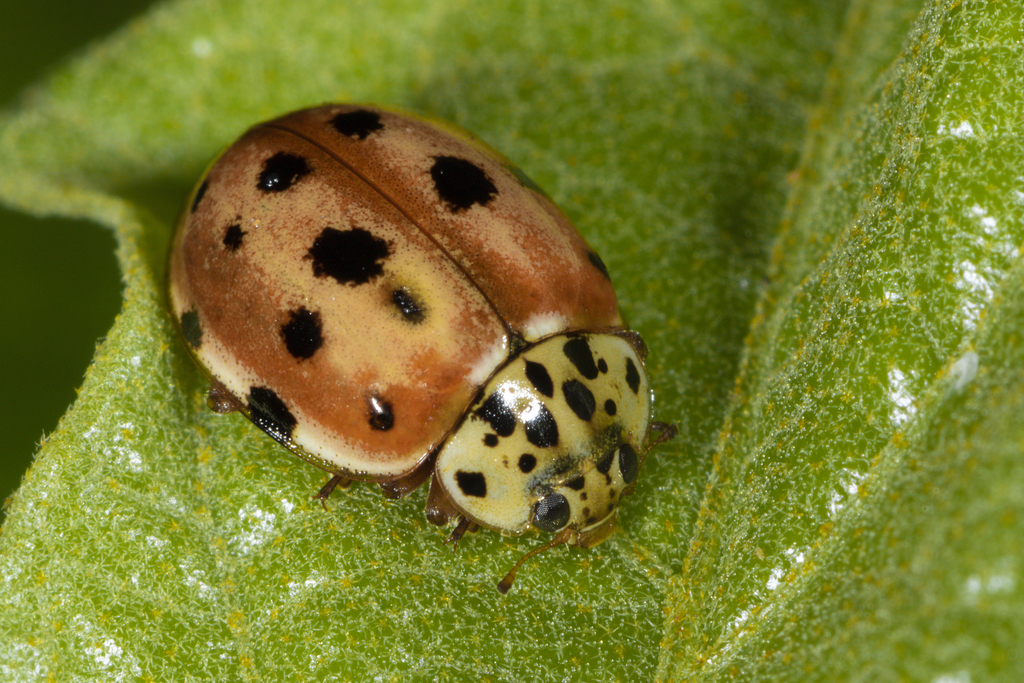
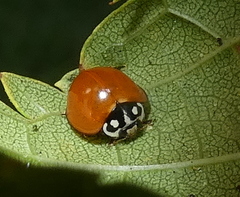
The cream-streaked ladybird is a relatively large ladybird, about 5.5 to 6 mm long. It is usually bright red, brown or yellow and many individuals show vertical pale streaks on the wing covers.
Source: Wikipedia
How to recognize it
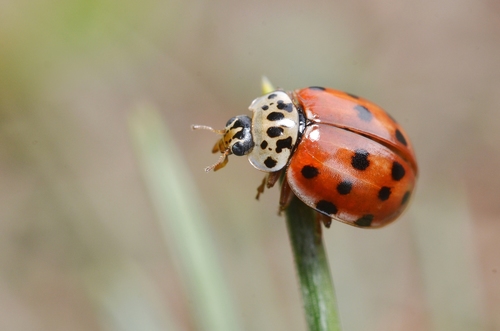
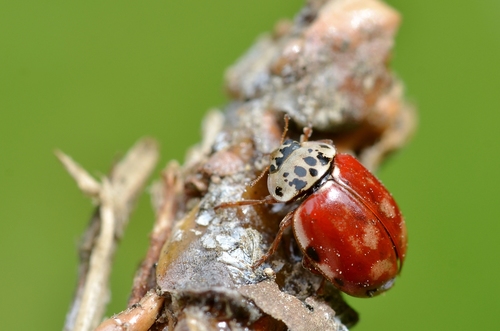
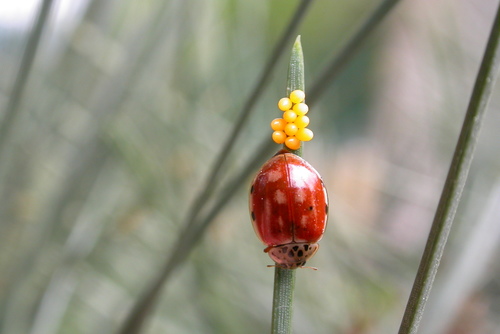
Colour varies from bright red, brown or yellow to almost black, and many have pale vertical lines on the elytra.
Source: Wikipedia
Size
Adults measure 5.5 to 6 mm in length.
Source: Wikipedia
Where it lives
They live in pine forests from lowlands up to hills.
Source: Wikipedia
What it eats
They are predators of aphids such as Lachnus pinicola.
Source: Wikipedia
Life cycle
Adults are active from March to October and overwinter under bark of deciduous and coniferous trees.
Source: Wikipedia
When you see it
Activity period runs from March through October.
Source: Wikipedia
Where it comes from
Their range covers most of Europe, the eastern Palearctic realm and the Near East.
Source: Wikipedia
Where it is found in the US
Recorded in 3 of 51 states and DC. Most records: Massachusetts, New Jersey, New York.
Darker = more records. Counts are museum and citizen-science records, not population size.
Source: GBIF
Status: introduced in Canada. Source: iNaturalist
More photos

Same family (Coccinellidae)

Sources
- Wikipedia: https://en.wikipedia.org/wiki/Harmonia_quadripunctata
Look it up elsewhere: GBIF · iNaturalist · BugGuide · ITIS · Wikipedia
Text written 2026-10-22 from the sources above and checked sentence by sentence against them. Data fetched 2026-10-22.