 Bug FAQ
Cottonwood Borer
Plectrodera scalator · Order: Coleoptera · Family: Cerambycidae
Source: Wikipedia
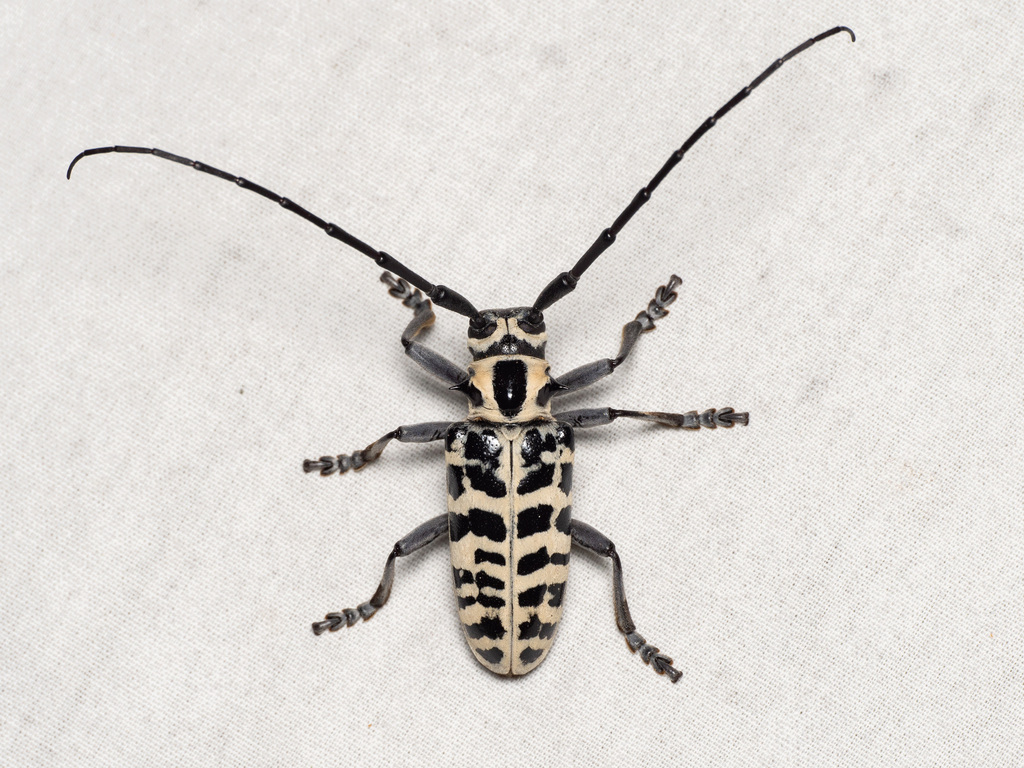
It is a large longhorn beetle up to 40 mm long with a black-and-white pattern and antennae as long as its body. Adults feed on leaf stems and bark of tender shoots, while larvae develop for up to two years in roots before pupating. The larvae can girdle and kill young cottonwood trees, though mature trees are usually not seriously harmed.
Source: Wikipedia
How to recognize it
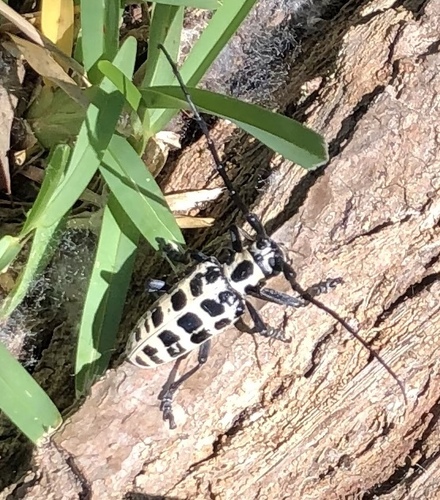
The adult has a black body with white patches caused by tiny hairs and long black antennae that reach or exceed its body length.
Source: Wikipedia
Size
It can grow up to 40 mm (1.6 in) long and about 12 mm (0.47 in) wide, making it one of the largest North American beetles.
Source: Wikipedia
Where it lives
It lives east of the Rocky Mountains in the United States and feeds on cottonwood trees.
Source: Wikipedia
What it eats
Larvae develop inside roots for up to two years before pupating for about three weeks.
Source: Wikipedia
Life cycle
Females chew small pits at the base of a tree to lay their eggs. After hatching, larvae grow for up to two years, then pupate underground for roughly three weeks.
Source: Wikipedia
Where it is found in the US
Recorded in 22 of 51 states and DC. Most records: Texas, Oklahoma, Kansas, New Mexico, Louisiana, Missouri, Arkansas, Florida.
Darker = more records. Counts are museum and citizen-science records, not population size.
Source: GBIF
Months it is reported in the US
Source: GBIF
More photos
Questions people ask
How can I recognize a cottonwood borer?
Look for a large black beetle with white hairy patches and antennae as long as its body.
Source: Wikipedia
How big does this beetle get?
It can reach about 40 mm in length and 12 mm in width.
Source: Wikipedia
What trees does it damage?
The larvae can girdle and kill young cottonwood trees, and weaken them so they may fall in strong winds.
Source: Wikipedia
What is the life cycle of the cottonwood borer?
Females lay eggs in small pits at a tree’s base; larvae develop for up to two years in roots, then pupate underground for about three weeks.
Source: Wikipedia
Same family (Cerambycidae)
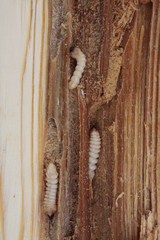 House LonghornHylotrupes bajulusCan damage your home
 Asian Longhorned BeetleAnoplophora glabripennisDamages trees, gardens or crops
 Red Milkweed BeetleTetraopes tetrophthalmus
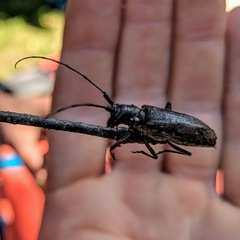 White-spotted SawyerMonochamus scutellatusCan damage your home
 Red Pine Longhorn BeetleStictoleptura rubra
 Spotted Longhorn BeetleRutpela maculataDamages trees, gardens or crops
Sources
- Wikipedia: https://en.wikipedia.org/wiki/Cottonwood_borer
Look it up elsewhere: GBIF · iNaturalist · BugGuide · ITIS · Wikipedia
Text written 2026-10-23 from the sources above and checked sentence by sentence against them. Data fetched 2026-10-23.