 Bug FAQ
Compsocerus violaceus
Compsocerus violaceus · Order: Coleoptera · Family: Cerambycidae
Source: Wikipedia

The beetle lives in southern Brazil, northern Argentina and Uruguay. Adults feed on fruit, flowers and tree sap, while larvae tunnel under bark and eat the wood of small branches. It is considered an agricultural pest that attacks several cultivated tree species.
Source: Wikipedia
How to recognize it
Compsocerus violaceus belongs to the long-horn beetle family.
Source: Wikipedia
Is it a pest in the house?
It is regarded as an agricultural pest that attacks several cultivated tree species.
Source: Wikipedia
Where it lives
It is found in South America, especially in southern Brazil, northern Argentina and Uruguay.
Source: Wikipedia
What it eats
Adult beetles eat fruits, flowers and sap that leaks from injured tree trunks. Larvae create galleries under bark on branches 2 to 6 cm thick and feed on the wood.
Source: Wikipedia
Life cycle
After hatching, larvae spend about ten months feeding inside the wood before emerging as adults.
Source: Wikipedia
Where it comes from
Its native range includes southern Brazil, northern Argentina and Uruguay.
Source: Wikipedia
Where it is found in the US
Recorded in 1 of 51 states and DC. Most records: Washington.
Darker = more records. Counts are museum and citizen-science records, not population size.
Source: GBIF
Questions people ask
What trees does this beetle damage?
It attacks several cultivated tree species, making it a crop pest.
Source: Wikipedia
What do the larvae feed on?
Larvae tunnel under bark and eat the wood of small branches.
Source: Wikipedia
Where is Compsocerus violaceus found?
It occurs in southern Brazil, northern Argentina and Uruguay.
Source: Wikipedia
Same family (Cerambycidae)
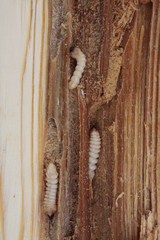 House LonghornHylotrupes bajulusCan damage your home
 Asian Longhorned BeetleAnoplophora glabripennisDamages trees, gardens or crops
 Red Milkweed BeetleTetraopes tetrophthalmus
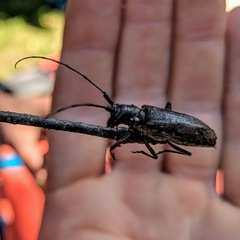 White-spotted SawyerMonochamus scutellatusCan damage your home
 Red Pine Longhorn BeetleStictoleptura rubra
 Spotted Longhorn BeetleRutpela maculataDamages trees, gardens or crops
Sources
- Wikipedia: https://en.wikipedia.org/wiki/Compsocerus_violaceus
Look it up elsewhere: GBIF · iNaturalist · BugGuide · Wikipedia
Text written 2026-10-23 from the sources above and checked sentence by sentence against them. Data fetched 2026-10-23.