 Bug FAQ
Common Green-Tenthredo
Tenthredo mesomela · Order: Hymenoptera · Family: Tenthredinidae
Also called: Common Green Sawfly
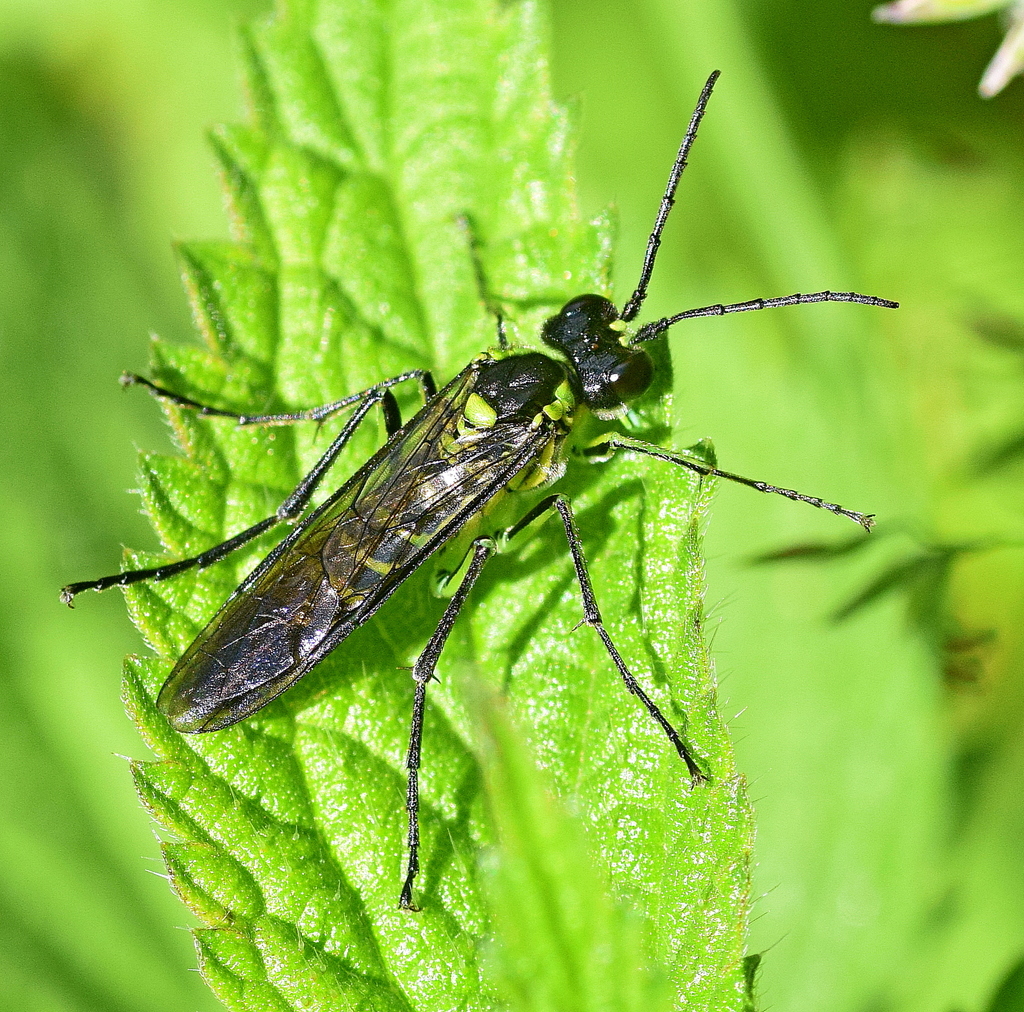
The common green-tenthredo is a small sawfly about 10 to 15 mm long with a yellow-to-apple-green body and a black head, thorax and abdomen top. Adults appear from May to July, feeding on small insects and the nectar and pollen of flowers, especially those in the carrot family. The nocturnal larvae eat the leaves of buttercup and Persicaria plants.
Source: Wikipedia
How to recognize it
Its body is yellow to apple green, while the head, thorax and the upper side of the abdomen are black; the pronotum and scutellum stay yellow. It can be told apart from similar Rhogogaster sawflies by the eye placement and a black wing spot (pterostigma), whereas Rhogogaster have a green one.
Source: Wikipedia
Size
It grows to about 10 to 15 mm (0.39 to 0.59 in) in length.
Source: Wikipedia
Where it lives
You’ll find it in meadows, along roadsides and at forest edges across most of Europe.
Source: Wikipedia
What it eats
Adults eat small insects and sip nectar and pollen, especially from Apiaceae flowers. Larvae feed at night on the leaves of buttercup (Ranunculus) and Persicaria species.
Source: Wikipedia
Life cycle
Adults are active from May through July, feeding on insects and flower resources. The larvae develop by eating buttercup and Persicaria leaves during the night.
Source: Wikipedia
When you see it
You’ll see the adults from May to July.
Source: Wikipedia
Where it comes from
Its range covers most of Europe, where it lives in open grassy and edge habitats.
Source: Wikipedia
Lookalikes
It resembles Rhogogaster sawflies but differs in eye position and a black pterostigma.
Source: Wikipedia
Same family (Tenthredinidae)
 Willow Apple Gall SawflyEuura californica
 Turnip SawflyAthalia rosaeNuisance, not dangerous
 Willow Redgall SawflyEuura proxima
 Yellow-spotted MacrophyaMacrophya montanaDamages trees, gardens or crops
 Saddleback Grass-cutterEutomostethus ephippiumDamages trees, gardens or crops
 Cherry Slug SawflyCaliroa cerasi
Sources
- Wikipedia: https://en.wikipedia.org/wiki/Tenthredo_mesomela
Look it up elsewhere: GBIF · iNaturalist · BugGuide · Wikipedia
Text written 2026-10-23 from the sources above and checked sentence by sentence against them. Data fetched 2026-10-22.