 Bug FAQ
Common Garden Orbweb Spider
Argiope australis · Order: Araneae · Family: Araneidae
Also called: Common Garden Orbweaver
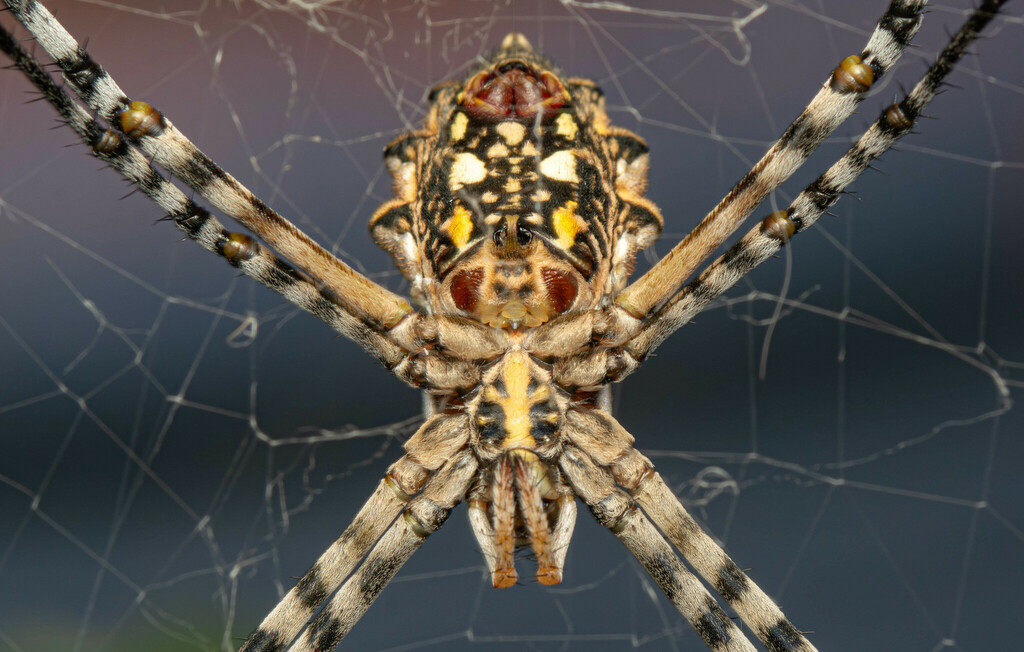
Females are about 25 mm long while males are only about 6 mm. The abdomen is bright yellow with black crosswise stripes when seen from above, and shows black with yellowish spots from below. They build orb webs low in shrubby vegetation in open grasslands and gardens across Africa.
Source: Wikipedia
How to recognize it
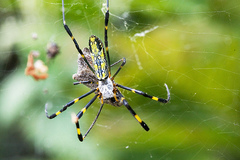
From above the spider’s abdomen is bright yellow with black crosswise stripes and a knobby outline. From below the abdomen appears darker with symmetrical yellowish spots and lines along its length. The legs show alternating light (white, orange, yellow) and dark (brown, black) bands.
Source: Wikipedia
Size
Females grow to about 25 mm, while males are much smaller at around 6 mm.
Source: Wikipedia
Where it lives
Webs are usually placed low in sturdy shrubby vegetation.
Source: Wikipedia
What it eats
The spider waits on its web for prey that becomes trapped.
Source: Wikipedia
Life cycle
Females are considerably larger than males, showing strong sexual size dimorphism.
Source: Wikipedia
Where it comes from
The species is widespread throughout Africa.
Source: Wikipedia
More photos


Questions people ask
How can I identify a Common Garden Orbweb Spider?
Look for a bright yellow abdomen with black crosswise stripes from above, dark underside with yellow spots, and legs with alternating light and dark bands.
Source: Wikipedia
Where does this spider build its web?
It builds low orb webs in shrubby vegetation within open grasslands and gardens.
Source: Wikipedia
Same family (Araneidae)


Sources
- Wikipedia: https://en.wikipedia.org/wiki/Argiope_australis
Look it up elsewhere: GBIF · iNaturalist · BugGuide · ITIS · Wikipedia
Text written 2026-10-23 from the sources above and checked sentence by sentence against them. Data fetched 2026-10-22.