 Bug FAQ
Common European Yellowjacket
Vespula vulgaris · Order: Hymenoptera · Family: Vespidae
Also called: Common Yellowjacket, Common European Wasp, Common Wasp
Source: Wikipedia

Workers are 12 to 17 mm long and queens about 20 mm; they have black and yellow markings with a single dagger-shaped black spot on the face. They live in many habitats, from forests and grasslands to gardens and buildings, and are native to the Palearctic region. Adults feed on nectar and sweet fruits, while larvae eat freshly killed insects and spiders; queens overwinter in sheltered holes.
Source: Wikipedia
How to recognize it
They show black and yellow colors, with parallel yellow bands on the pronotum and black dots on the abdomen. From the front, the face has only one black mark on the clypeus, shaped like an anchor or dagger, unlike the three dots of V. germanica.
Source: Wikipedia
Size
Workers measure about 12 to 17 mm and weigh around 84 mg; queens are roughly 20 mm long.
Source: Wikipedia
Is it a pest in the house?
They are common in urban areas and can become pests by damaging fruit crops and posing a risk to humans.
Source: Wikipedia
Does it bite or sting?
Unlike honey bees, they can sting repeatedly, delivering a painful venom that contains histamine, serotonin, peptides and enzymes.
Source: Wikipedia
How to get rid of it
If you are unsure of identification, use several characteristics and consult an expert.
Source: Wikipedia
Where it lives
They thrive in prairies, grasslands, forests, shrublands, gardens, orchards, and even inside buildings.
Source: Wikipedia
What it eats
Adults collect nectar and sweet fruits for energy, while larvae eat freshly killed insects such as caterpillars, bees, flies, and spiders.
Source: Wikipedia
Life cycle
After mating, the queen overwinters in a protected hole or building cavity.
Source: Wikipedia
When you see it
They forage when temperatures are above about 2 °C (36 °F).
Source: Wikipedia
Where it comes from
The species is native to the Palearctic region.
Source: Wikipedia
Lookalikes
They look very similar to V. germanica, but the single black mark on the face distinguishes them when viewed head-on.
Source: Wikipedia
Where it is found in the US
Recorded in 24 of 51 states and DC. Most records: Minnesota, West Virginia, Colorado, Utah, Illinois, California, Ohio, Michigan.
Darker = more records. Counts are museum and citizen-science records, not population size.
Source: GBIF
Months it is reported in the US
Source: GBIF
More photos

Questions people ask
Can they sting multiple times?
Yes, they can sting repeatedly and their sting is painful.
Source: Wikipedia
How can I tell them apart from German wasps?
Look at the face; V. vulgaris has a single dagger-shaped black spot, while V. germanica has three black dots.
Source: Wikipedia
Where do they build nests?
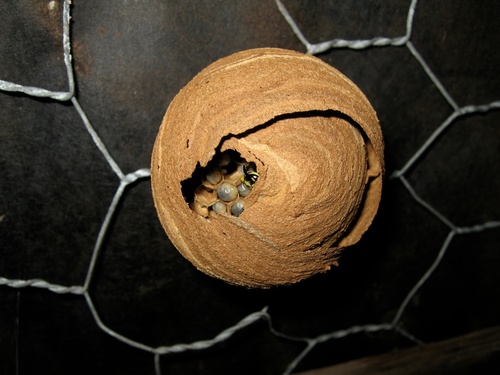
Queens overwinter in sheltered holes or building cavities, and new nests are built each year.
Source: Wikipedia
Do they damage gardens or crops?
They can damage fruit crops and become a nuisance in gardens and orchards.
Source: Wikipedia
Same family (Vespidae)


Sources
- Wikipedia: https://en.wikipedia.org/wiki/Vespula_vulgaris
Look it up elsewhere: GBIF · iNaturalist · BugGuide · Wikipedia
Text written 2026-10-22 from the sources above and checked sentence by sentence against them. Data fetched 2026-10-22.