 Bug FAQ
Common Eucalyptus Longhorn
Phoracantha semipunctata · Order: Coleoptera · Family: Cerambycidae
Also called: Eucalyptus Longhorn Borer, Eucalyptus Longhorned Borer
Source: Wikipedia
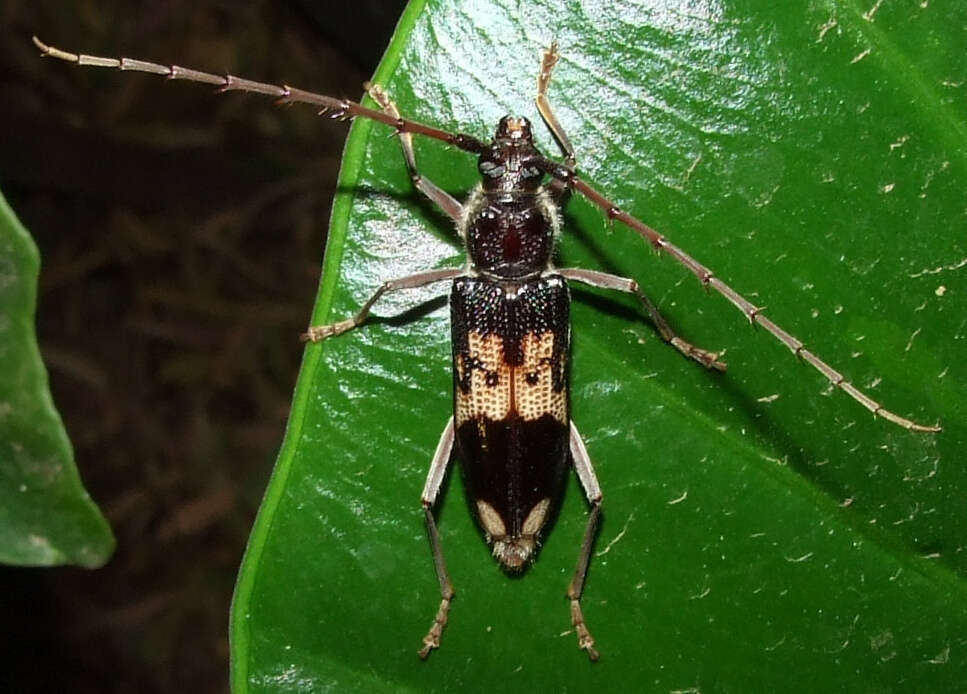
Adults are dark brown to reddish beetles about 2.3 cm long, with a protruding spine at the rear. They are native to Australia but have become invasive elsewhere, where they can kill Eucalyptus trees by larval feeding.
Source: Wikipedia
How to recognize it
The beetle’s body is a darker reddish colour and ends in a noticeable spine.
Source: Wikipedia
Size
Adults measure between 15 and 23 mm, with females slightly larger than males. They are roughly 2.3 cm long overall.
Source: Wikipedia
Is it a pest in the house?
In regions where it is introduced, the beetle causes serious damage to cultivated Eucalyptus trees.
Source: Wikipedia
Where it lives
They are most active at dusk in warm, arid areas that have many Eucalyptus trees.
Source: Wikipedia
What it eats
Adults feed on pollen and nectar of their host trees during spring and summer evenings. Larvae feed inside the wood, destroying the cambium and can kill the whole tree.
Source: Wikipedia
Life cycle
Larvae grow for up to 2.5 months, reaching 30 to 40 mm, are creamy and legless. Development time varies with the condition of the host tree.
Source: Wikipedia
When you see it
Adults appear in spring and summer, becoming active at evening hours.
Source: Wikipedia
Where it comes from
The species originates from Australia. Outside Australia it is considered an invasive pest of Eucalyptus.
Source: Wikipedia
Lookalikes
It resembles P. recurva but is larger and has more extensive dark markings.
Source: Wikipedia
Where it is found in the US
Recorded in 2 of 51 states and DC. Most records: California, Hawaii.
Darker = more records. Counts are museum and citizen-science records, not population size.
Source: GBIF
Months it is reported in the US
Source: GBIF
Questions people ask
How can I identify the Common Eucalyptus Longhorn?
Look for a dark reddish beetle about 2.3 cm long with a spine at the end; females are slightly larger than males.
Source: Wikipedia
When are these beetles active?
Adults are most active at dusk during the warmer spring and summer months.
Source: Wikipedia
What damage do they cause to trees?
Larvae feed inside the wood, destroying the cambium layer and can kill the entire Eucalyptus tree.
Source: Wikipedia
Same family (Cerambycidae)
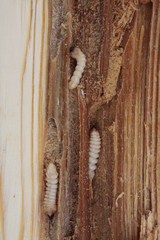 House LonghornHylotrupes bajulusCan damage your home
 Asian Longhorned BeetleAnoplophora glabripennisDamages trees, gardens or crops
 Red Milkweed BeetleTetraopes tetrophthalmus
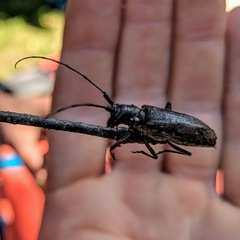 White-spotted SawyerMonochamus scutellatusCan damage your home
 Red Pine Longhorn BeetleStictoleptura rubra
 Spotted Longhorn BeetleRutpela maculataDamages trees, gardens or crops
Sources
- Wikipedia: https://en.wikipedia.org/wiki/Phoracantha_semipunctata
Look it up elsewhere: GBIF · iNaturalist · BugGuide · ITIS · Wikipedia
Text written 2026-10-23 from the sources above and checked sentence by sentence against them. Data fetched 2026-10-22.