 Bug FAQ
Common candy-striped spider
Enoplognatha ovata · Order: Araneae · Family: Theridiidae
Also called: Candy-striped Spider complex
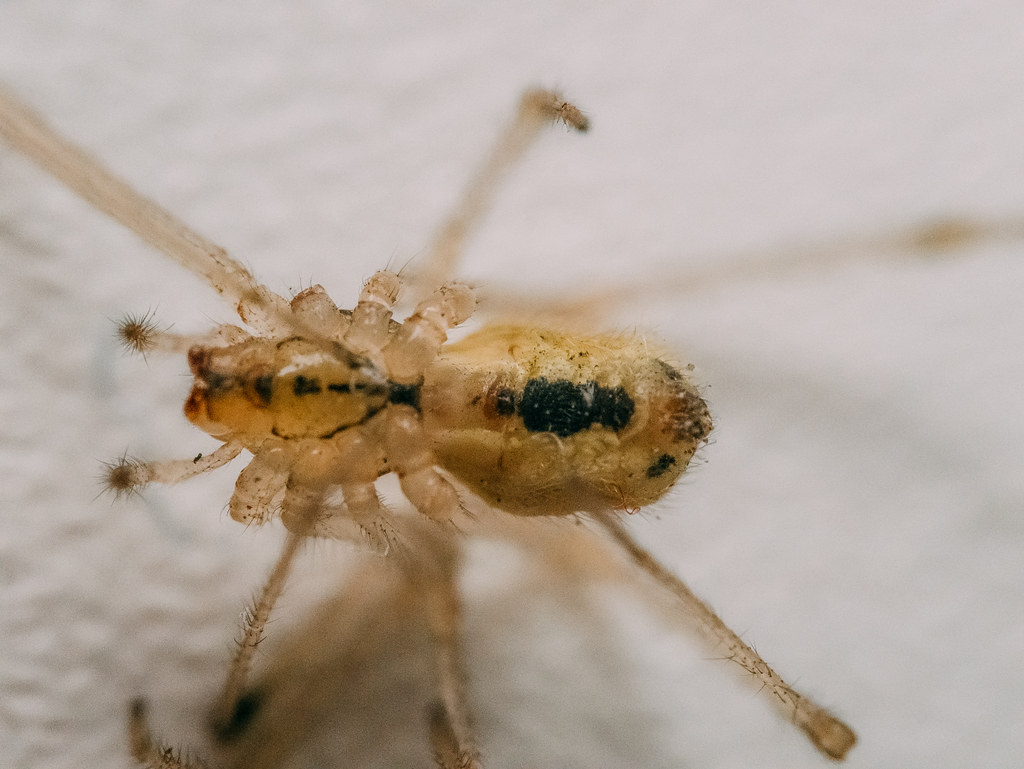
The common candy-striped spider reaches about 6 mm in body length, not counting its legs. It lives in open fields, forests, and roadsides, often under leaves or low vegetation, and tends to form dense clumps or colonies. Native to Europe, it has spread across the United States from coast to coast, but not into Mexico.
Source: Wikipedia
How to recognize it
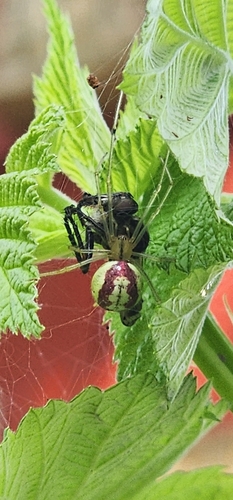
Three colour forms exist: “Lineata” with a yellow or cream abdomen, “Redimita” with two dorsal red stripes, and “Ovata” where the whole dorsal surface is red.
Source: Wikipedia
Size
Adults measure about 6 mm in body length, excluding the legs.
Source: Wikipedia
Where it lives
They are found in open fields, forests, and along roadsides, usually on the undersides of leaves and low vegetation. Populations often occur in dense clumps that are sometimes called colonies.
Source: Wikipedia
What it eats
Despite its small size, it can capture and eat insects many times larger than itself.
Source: Wikipedia
Life cycle
Females lay eggs in a white sac that later turns blue-grey. Mothers have been seen guarding the eggs and even bringing prey to their spiderlings.
Source: Wikipedia
Where it comes from
The species is native to Europe and has been introduced throughout North America. In the United States it occurs coast-to-coast but does not extend as far south as Mexico.
Source: Wikipedia
Lookalikes
To the naked eye they look the same as Enoplognatha latimana; only the male palpal bulb and female epigyne differ.
Source: Wikipedia
Where it is found in the US
Recorded in 30 of 51 states and DC. Most records: Washington, Maine, Oregon, Wisconsin, Michigan, Colorado, Vermont, Ohio.
Darker = more records. Counts are museum and citizen-science records, not population size.
Source: GBIF
Status: introduced in North America; introduced in United States; introduced in Canada. Source: iNaturalist
Months it is reported in the US
Source: GBIF
More photos

Questions people ask
Are they a garden pest?
The spider is a predator of insects and is not reported to damage plants.
Source: Wikipedia
Same family (Theridiidae)


Sources
- Wikipedia: https://en.wikipedia.org/wiki/Enoplognatha_ovata
Look it up elsewhere: GBIF · iNaturalist · BugGuide · ITIS · Wikipedia
Text written 2026-10-22 from the sources above and checked sentence by sentence against them. Data fetched 2026-10-22.