 Bug FAQ
Clemens' Bark Moth
Xylesthia pruniramiella · Order: Lepidoptera · Family: Tineidae
Also called: Speckled Xylesthia Moth

Clemens' bark moth is a tiny moth with a wingspan of about 13 mm. It lives across the eastern United States, from New Hampshire down to Florida and west to Texas. Adults can be seen flying from February through December.
Source: Wikipedia
How to recognize it
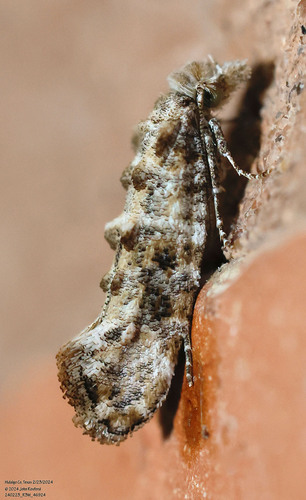
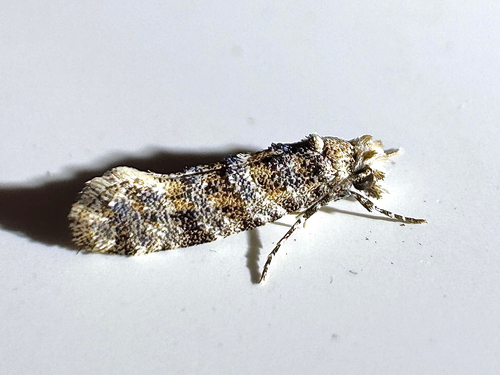
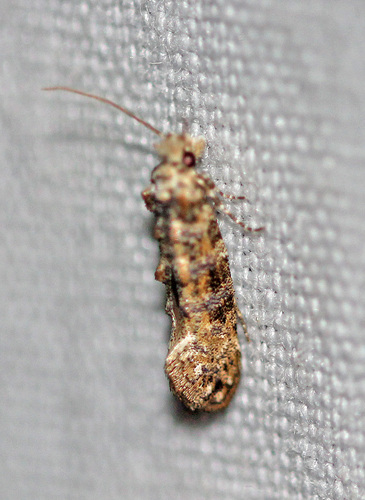
The forewings are dark brown with yellowish tones, whitish patches, and several faint white streaks, plus a white spot near the inner angle and a black tip edged in white; hindwings are dark brown with a reddish tint.
Source: Wikipedia
Size
The wingspan ranges from 12.7 to 13.7 mm.
Source: Wikipedia
What it eats
The larvae feed on woody growths that appear on plum tree branches.
Source: Wikipedia
Life cycle
Adults are on the wing from February through December.
Source: Wikipedia
When you see it
You can see adults almost year-round, from February to December.
Source: Wikipedia
Where it comes from
It is native to North America, found from New Hampshire south to Florida and west to Texas.
Source: Wikipedia
Where it is found in the US
Recorded in 40 of 51 states and DC. Most records: Texas, Mississippi, Pennsylvania, Maryland, New York, Massachusetts, Louisiana, New Jersey.
Darker = more records. Counts are museum and citizen-science records, not population size.
Source: GBIF
Status: native in North America; native in Canada; native in United States. Source: iNaturalist
Months it is reported in the US
Source: GBIF
More photos
Questions people ask
When are Clemens' bark moths active?
Adults can be seen flying from February through December.
Source: Wikipedia
What do the larvae eat?
The larvae feed on woody excrescences on plum tree branches.
Source: Wikipedia
Where is this moth found?
It occurs in the eastern United States, from New Hampshire to Florida and west to Texas.
Source: Wikipedia
Same family (Tineidae)


Sources
- Wikipedia: https://en.wikipedia.org/wiki/Xylesthia_pruniramiella
Look it up elsewhere: GBIF · iNaturalist · BugGuide · Wikipedia
Text written 2026-10-24 from the sources above and checked sentence by sentence against them. Data fetched 2026-10-24.