 Bug FAQ
Chilean Stag Beetle
Chiasognathus grantii · Order: Coleoptera · Family: Lucanidae
Also called: Darwin's Beetle

Male Chilean stag beetles can grow up to about 90 mm long, while females are less than half that size. They live in temperate Nothofagus forests of Argentina and Chile and feed on tree sap as adults and dead wood as larvae.
Source: Wikipedia
How to recognize it
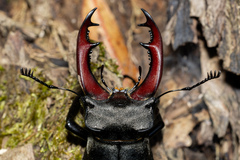
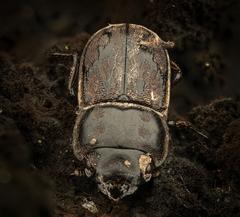
Males have very robust, finely serrated upper mandibles that are longer than their bodies. The beetles’ wing covers are chestnut-brown with a slight green iridescence and a fine granulated texture.
Source: Wikipedia
Size
Males reach 60 to 90 mm in total length, including the mandibles; females are only 25 to 37 mm long.
Source: Wikipedia
Does it bite or sting?
Even though males have large mandibles, they are not strong enough to cause pain if they bite a finger.
Source: Wikipedia
Where it lives
They inhabit temperate to sub-antarctic Nothofagus forests.
Source: Wikipedia
What it eats
Adults mainly drink tree juices, while the larvae consume dead wood.
Source: Wikipedia
Life cycle
The beetle is considered rare and vulnerable, with populations at risk of decline.
Source: Wikipedia
Where it comes from
The species is native to Argentina and Chile.
Source: Wikipedia
Lookalikes
It has been called Tetropthalma chiloensis and also Chiasognathus affinis in older literature.
Source: Wikipedia
More photos


Questions people ask
Do Chilean stag beetles hurt if they pinch?
Not much. Darwin noted the males' huge jaws were not strong enough to hurt a finger.
Source: Wikipedia
Where can I find Chilean stag beetles?
They live in temperate Nothofagus forests of Argentina and Chile.
Source: Wikipedia
Same family (Lucanidae)



Sources
- Wikipedia: https://en.wikipedia.org/wiki/Chiasognathus_grantii
Look it up elsewhere: GBIF · iNaturalist · BugGuide · Wikipedia
Text written 2026-10-23 from the sources above and checked sentence by sentence against them. Data fetched 2026-10-23.