 Bug FAQ
Black-shouldered Shieldbug
Carpocoris pudicus · Order: Hemiptera · Family: Pentatomidae
Source: Wikipedia
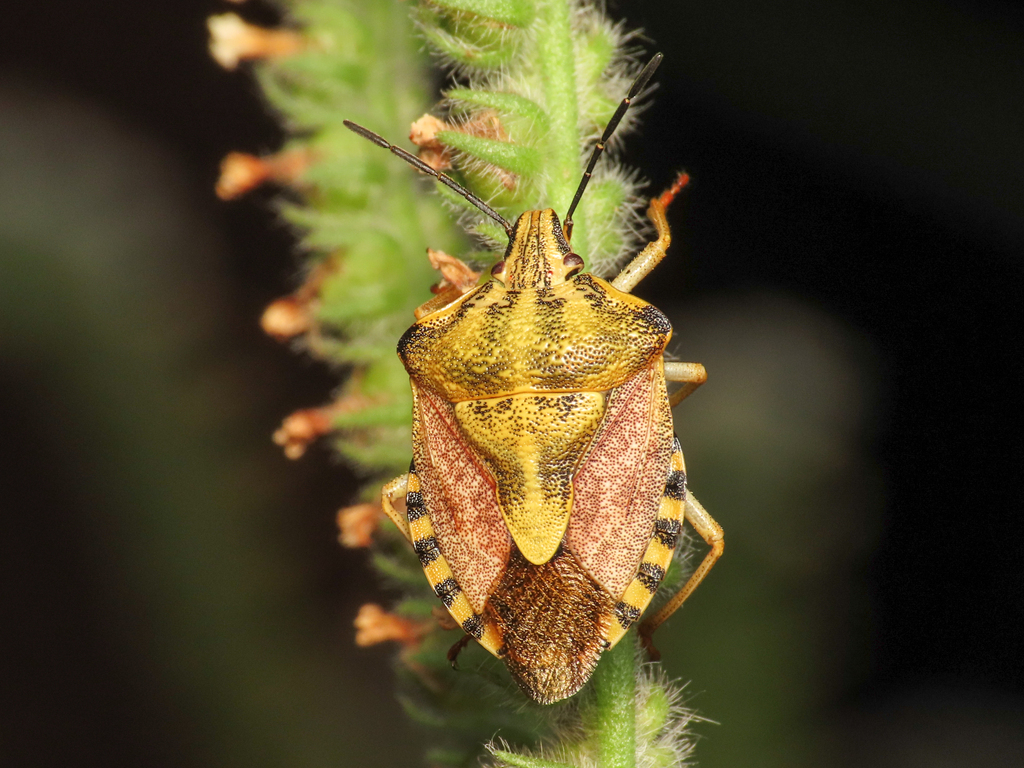
Carpocoris pudicus is about 11 mm long and lives in sunny, hot, dry places across central and southern Europe. It feeds on a variety of plants in the carrot, daisy and grass families, which can make it a garden and field pest.
Source: Wikipedia
How to recognize it
Each male paramere has a single tooth on its head, and the pronotum’s humeral angles are rounded with a black spot.
Source: Wikipedia
Size
Adults reach about 11 mm (0.43 in) in body length.
Source: Wikipedia
Where it lives
They prefer sunny, hot and dry habitats.
Source: Wikipedia
What it eats
They are polyphagous, mainly feeding on plants from the Apiaceae, Asteraceae and Poaceae families.
Source: Wikipedia
Lookalikes
It looks similar to Carpocoris mediterraneus but can be told apart by its blunt, non-pointed pronotum angles and a pronotum and abdomen of equal width.
Source: Wikipedia
More photos

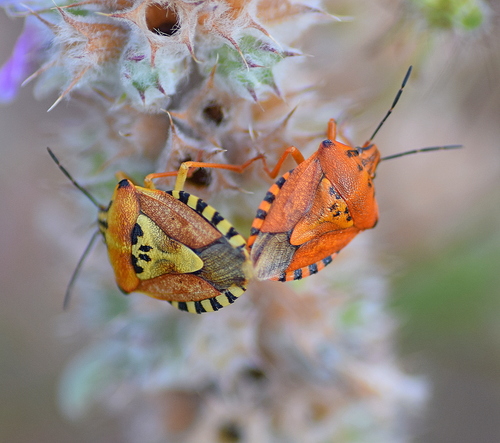
Questions people ask
What plants does Carpocoris pudicus feed on?
It mainly eats members of the carrot, daisy and grass families (Apiaceae, Asteraceae, Poaceae).
Source: Wikipedia
Is Carpocoris pudicus a pest for gardens or crops?
Yes, because it feeds on many garden and field plants, it can become a crop-pest.
Source: Wikipedia
Where is Carpocoris pudicus found in Europe?
It occurs widely across central and southern Europe, from France and Germany to Greece and the Balkans.
Source: Wikipedia
Same family (Pentatomidae)
 Brown Marmorated Stink BugHalyomorpha halysDamages trees, gardens or crops
 Green Stink BugChinavia hilarisDamages trees, gardens or crops
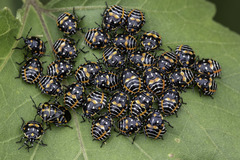 Harlequin BugMurgantia histrionicaDamages trees, gardens or crops
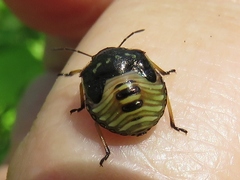 Brown Stink BugEuschistus servusDamages trees, gardens or crops
 Green Shield BugPalomena prasina
 European Striped Shield BugGraphosoma italicum
Sources
- Wikipedia: https://en.wikipedia.org/wiki/Carpocoris_pudicus
Look it up elsewhere: GBIF · iNaturalist · BugGuide · Wikipedia
Text written 2026-10-23 from the sources above and checked sentence by sentence against them. Data fetched 2026-10-22.