 Bug FAQ
Carolina Pine Sawyer
Monochamus carolinensis · Order: Coleoptera · Family: Cerambycidae
Source: Wikipedia
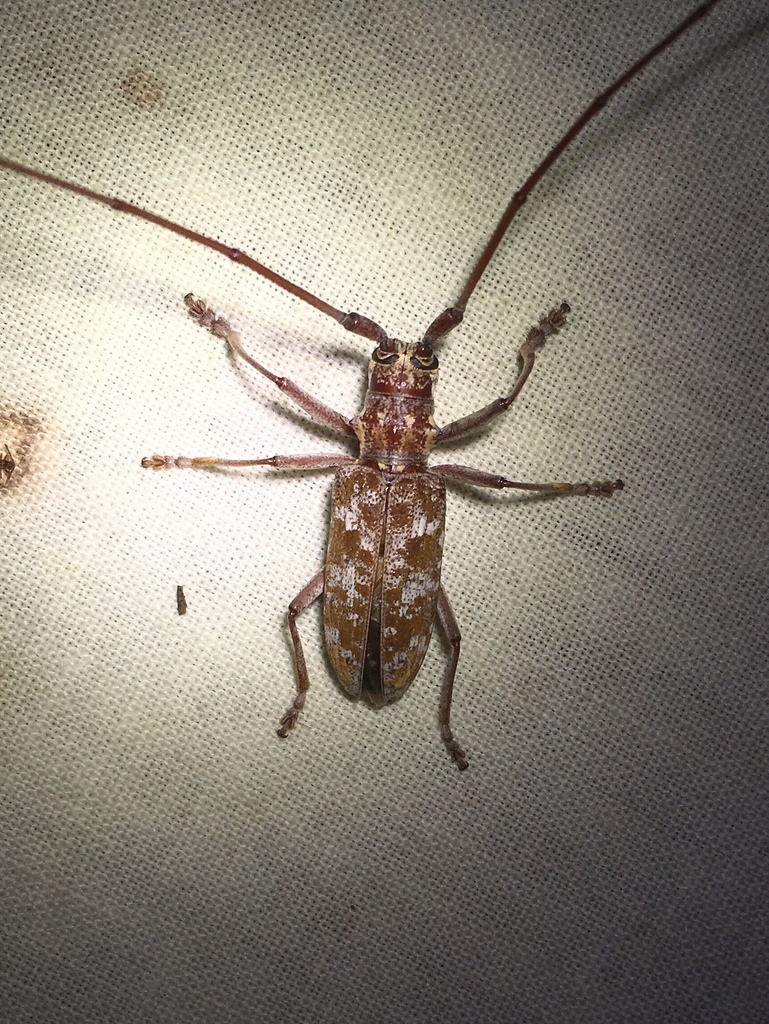
Carolina Pine Sawyer beetles look like Monochamus titillator but have a shallower elytral angle and a more rounded tip, and the males have shorter antennae relative to body length (about twice the body length). Adults are active from May through September in the southeastern United States, producing about one to one-and-a-half generations per year, and they feed on live pine twigs while females lay eggs on dead pine wood. The species is found in Canada and the United States and can act as a vector of pine wilt disease.
Source: Wikipedia
How to recognize it
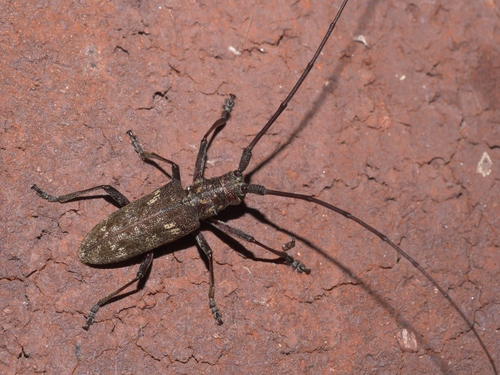
It resembles Monochamus titillator but the elytral edge meets the midline at a shallower angle and the tip of the elytra is more rounded. Male antennae are about twice the body length, shorter than in M. titillator.
Source: Wikipedia
Is it a pest in the house?
Females lay eggs on dead pine trees, both standing and felled. Adults feed on live pine twigs and may spread pine wilt disease.
Source: Wikipedia
Where it lives
It occurs in Canada and the United States.
Source: Wikipedia
What it eats
Adults fly to feed on the twigs of living pine trees.
Source: Wikipedia
Life cycle
Females lay one to three eggs in niches they cut between the outer bark and phloem of dead standing or fallen pine trees.
Source: Wikipedia
When you see it
Adults are active from May through September in the southeastern United States.
Source: Wikipedia
Where it comes from
It is native to Canada and the United States.
Source: Wikipedia
Lookalikes
It can be confused with Monochamus titillator; the latter has a steeper elytral angle and a less rounded elytral tip.
Source: Wikipedia
Where it is found in the US
Recorded in 36 of 51 states and DC. Most records: North Carolina, Alabama, Maryland, Florida, Georgia, Louisiana, Texas, South Carolina.
Darker = more records. Counts are museum and citizen-science records, not population size.
Source: GBIF
Status: native in North America; native in Canada. Source: iNaturalist
Months it is reported in the US
Source: GBIF
More photos
Questions people ask
How can I tell Carolina Pine Sawyer apart from similar beetles?
Look for a shallower angle where the elytra meet the midline and a more rounded elytral tip, and note that males have antennae about twice their body length, shorter than in the similar species.
Source: Wikipedia
When are these beetles active?
Adults are active from May through September in the southeastern United States.
Source: Wikipedia
Do they spread disease?
Yes, they can act as a vector of pine wilt disease while feeding on live pine twigs.
Source: Wikipedia
Same family (Cerambycidae)
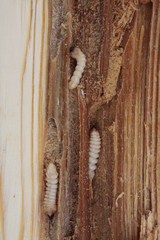 House LonghornHylotrupes bajulusCan damage your home
 Asian Longhorned BeetleAnoplophora glabripennisDamages trees, gardens or crops
 Red Milkweed BeetleTetraopes tetrophthalmus
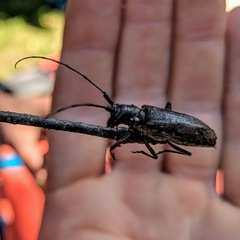 White-spotted SawyerMonochamus scutellatusCan damage your home
 Red Pine Longhorn BeetleStictoleptura rubra
 Spotted Longhorn BeetleRutpela maculataDamages trees, gardens or crops
Sources
- Wikipedia: https://en.wikipedia.org/wiki/Monochamus_carolinensis
Look it up elsewhere: GBIF · iNaturalist · BugGuide · ITIS · Wikipedia
Text written 2026-10-23 from the sources above and checked sentence by sentence against them. Data fetched 2026-10-23.